
If you’re raising institutional capital, especially from a Micro-PE or growth-oriented fund, the Investment Committee (IC) is the real arena.
The partner meeting is theatre.
The IC is underwriting.
Given your orientation toward scalable, revenue-proven, unit-economics-driven businesses, this piece is written from the lens of how serious capital allocators think, not how pitch decks are designed.
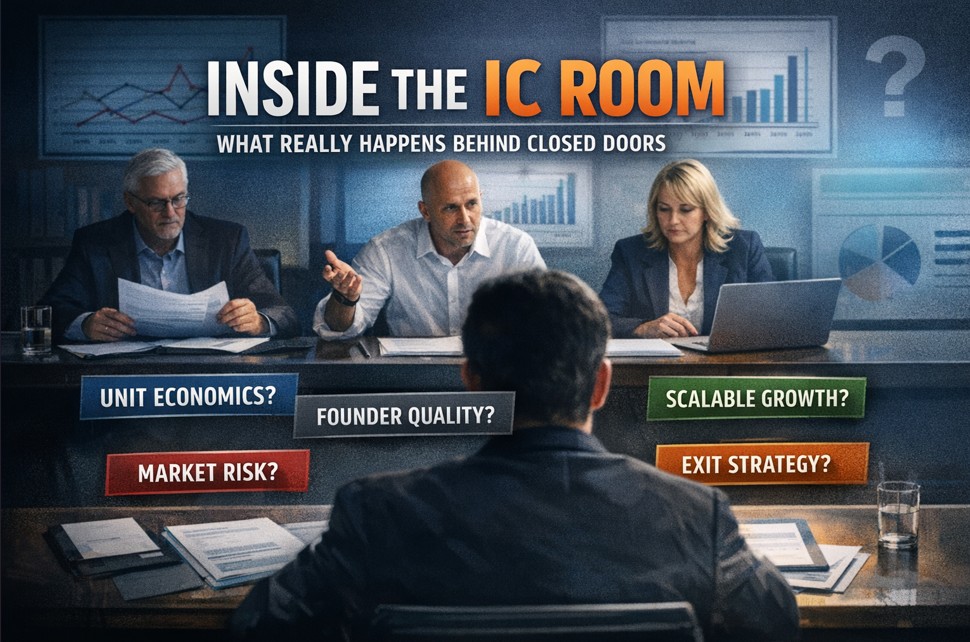
1. What Is an IC, Really?
An Investment Committee is not a brainstorming room.
It is a risk-pricing forum.
Participants typically include:
- Managing Partner
- Investment team
- Sometimes external advisors
- Occasionally sector specialists
Their job is not to be impressed.
Their job is to answer one question:
Is the risk-adjusted return profile acceptable relative to our capital mandate?
Everything else is secondary.
2. What Actually Happens Behind Closed Doors
Here’s the anatomy of a typical IC discussion.
Phase 1: Deal Champion Presentation
The internal sponsor (usually the partner who likes the deal) presents:
- Business overview
- Traction metrics
- Unit economics
- Founder assessment
- Market opportunity
- Entry valuation
- Key risks
This is where your story is re-told, without you in the room.
If your thesis is unclear, this is where it collapses.
Phase 2: Structured Dissection
Now the room shifts tone. Expect questions like:
1. Scalability vs Sellability
- Is revenue founder-driven?
- Is growth process-driven or personality-driven?
- Is customer acquisition repeatable?
If revenue depends heavily on the founder, IC flags key-man risk.
2. Unit Economics
IC doesn’t care about vanity growth. They ask:
- Contribution margin?
- CAC payback period?
- Retention curves?
- Operating leverage visibility?
If unit economics are “improving soon,” that’s not underwriting, that’s hope.
3. Market Reality
- Is TAM real or deck-constructed?
- Are customers switching from alternatives?
- Is this a budget line item or experimental spend?
4. Founder Quality
Behind closed doors, this is blunt.
Questions asked:
- Does the founder have staying power?
- Are they coachable?
- Do they understand capital efficiency?
- Have they faced adversity?
Charisma helps in meetings.
Resilience matters in IC.
5. Exit Pathways
Especially for PE-style funds:
- Who buys this?
- When?
- At what multiple?
- Is this a platform or a feature?
No clear exit logic = weak IC conviction.
3. The Hidden Filters IC Uses (That Founders Don’t See)
From experience with disciplined capital allocators, here are silent filters:
▪ Revenue Quality > Revenue Quantity
Repeat revenue with proof of retention beats flashy GMV.
▪ Founder Energy vs Endurance
Can you do this for 7-10 years?
▪ Capital Efficiency
How much follow-on funding will this require before stability?
▪ Optionality
Is there adjacency expansion potential?
4. How Founders Should Prepare for IC (Strategically)
If you’re serious about institutional capital, prepare for the IC, not just the partner call.
1. Pre-Answer Risk
List the top 5 risks in your own business.
If you don’t know them, IC will.
Then prepare:
- Data
- Mitigation plan
- Timeline to de-risk
Confidence without risk awareness kills credibility.
2. Make Unit Economics Boringly Clear
Have:
- Cohort tables
- CAC breakdown
- LTV logic
- Fixed vs variable cost structure
If numbers require storytelling, IC assumes fragility.
3. Show Scalability Mechanism
Not ambition, mechanism.
Examples:
- Channel expansion playbook
- Pricing power evidence
- Repeatable sales engine
- Hiring model
4. Understand the Fund’s Mandate
Not all capital is the same.
VCs underwrite narrative expansion.
PE-style funds underwrite cash-flow visibility.
If you pitch hyper-growth to a capital-efficiency fund, you create misalignment.
5. What Founders Often Misunderstand
❌ “If one partner likes us, we’re in.”
Wrong.
The IC can veto.
❌ “We just need momentum.”
Momentum without unit economics = delayed failure.
❌ “ICs focus only on numbers.”
No.
They focus on risk-adjusted durability.
6. What Makes IC Say Yes
In my observation of disciplined investors:
- Clear revenue proof
- Improving unit economics
- Founder with staying power
- Scalable system (not personality-driven sales)
- Realistic valuation
- Logical exit pathway
When these align, IC discussions become short.
When they don’t, meetings stretch.
7. A Brutal Truth
Behind closed doors, this sentence gets spoken often:
“I like the founder. I’m just not sure this is underwriteable yet.”
That doesn’t mean no forever.
It means “come back when risk is lower.”
Smart founders treat IC objections as a roadmap, not rejection.
8. Final Advice to Founders
Prepare like this:
- Think like a capital allocator
- Audit your own weaknesses
- Make risk visible before it’s discovered
- Understand what kind of capital you are raising
And most importantly:
Don’t optimize for raising. Optimize for building something that is hard to say no to.