
Part 9 of 15 in Stress Management for Indian Founders: A Practical Guide to Completing the Stress Cycle, Recovering Properly, and Building Without Burning Out← Part 8Part 10 →
This chapter shares patterns from Indian founders facing funding pressure, family responsibilities, gendered workload, and differences between major cities and Tier-2 locations. It helps founders identify recovery practices and boundaries that support clearer decisions and long-term sustainability.
- Founders who used walks, family evenings, or breathing practices reported clearer decisions and fewer anxiety-driven changes.
- Company-free times, visual signals, and family meetings helped reduce interruptions in multi-generational households.
- Women founders often manage household, elder care, and child logistics alongside company stress.
- AI tools and explicit recovery-time agreements helped reduce cognitive load for several women founders.
- Tier-2 city founders may face less hustle pressure but more logistical friction and fewer peer communities.
The Funding Winter Pattern
Multiple founders across Pune, Bangalore, and Delhi described similar trajectories during the 2022-2024 period: rapid growth expectations meeting sudden capital scarcity. A common pattern among founders who coped better was explicit cycle-completion rituals (daily walks, protected family evenings, short breathing practices), which tend to support clearer decisions and fewer impulsive hires or product pivots driven by anxiety. Treating every day as pure crisis mode tends to feed co-founder conflict and health problems. The external conditions were similar. The internal recovery practices differed.
The Multi-Generational Household Reality
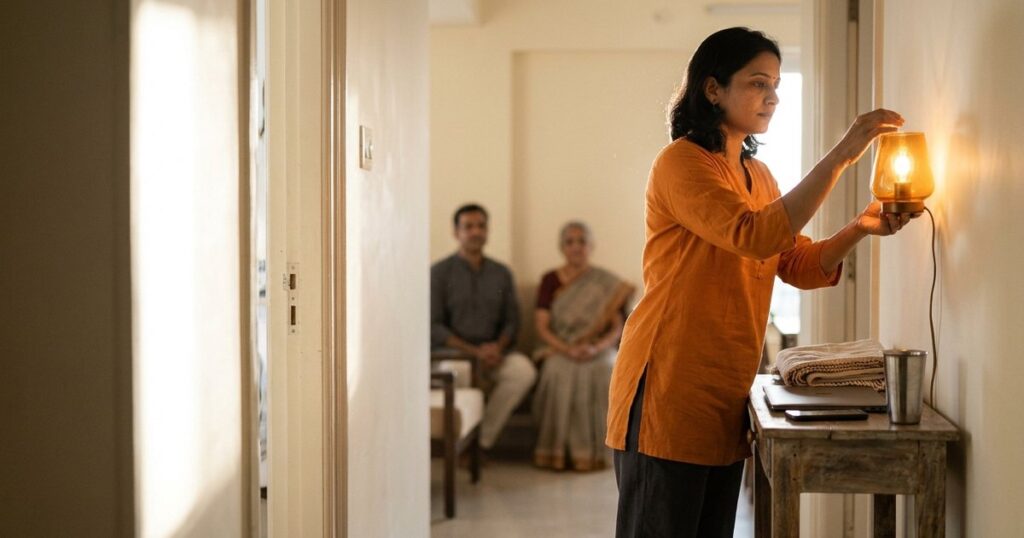
Founders living with or supporting parents often face unique boundary challenges. Successful ones negotiate explicit company-free zones or times with family members. One Jaipur founder created a simple visual signal (a closed door or a specific lamp) that meant deep work or recovery in progress. Family respected it once the purpose was explained in terms of long-term family security rather than personal preference. Another founder in Lucknow schedules a weekly family meeting to surface logistics so that ad-hoc interruptions decrease.
The Women Founder Overlay
Women founders frequently carry additional invisible labor, household coordination, elder care, child logistics, on top of company stress. Completing the cycle and protecting recovery becomes even more critical. Several women founders have successfully used AI tools to offload planning and decision support so that cognitive load is reduced even when time is scarce. Explicit negotiation with partners and family about recovery time is often necessary and, when framed around long-term sustainability of the venture, usually successful.
The Tier-2 City Advantage and Challenge
Founders outside the major metros sometimes face fewer social pressures around visible hustle but more logistical friction. One Indore founder used the relative calm of his city to build stronger recovery habits early. The challenge was access to peer communities; he solved it with regular virtual founder circles focused as much on personal sustainability as on metrics.
Frequently asked questions
How did founders cope with the funding winter from 2022 to 2024?
Founders who used daily walks, protected family evenings, and short breathing practices tended to make clearer decisions and fewer impulsive hires or product pivots.
How can founders set boundaries while living with family?
They can agree on company-free times or use a signal, such as a closed door or specific lamp, to show that deep work or recovery is in progress.
Why is recovery especially important for women founders?
Women founders may carry household coordination, elder care, and child logistics alongside company stress. Recovery time and planning support can reduce cognitive load.
What are the advantages and challenges for founders in Tier-2 cities?
They may face fewer social pressures around visible hustle but more logistical friction. Virtual founder circles can help address limited access to peer communities.