
Discover the power of customer personas in enterprise software. Learn how to develop accurate profiles that surface real insights, sharpen product development, and improve your marketing.
How to build a customer persona, step by step
To develop customer personas for your startup, follow these steps:
Identify your target audience: To develop customer personas for your startup, start by figuring out who exactly is your target customers. Considering factors such as the industry, size of the company (either team/revenues), job roles, location etc helps refine your persona. For instance, if your software is meant for human resources departments in mid-sized technology companies located in North America, then that’s your target audience.
Conduct market research: Gather data and insights to understand your target audience better. Utilize surveys, interviews, and industry reports to collect information about their pain points, goals, and preferences. Identify common challenges faced by your potential customers and the specific benefits your software can offer.
Segment your audience: Divide your target audience into meaningful segments based on shared characteristics. This segmentation can be based on industry, company size, job function, or any other relevant criteria. For instance, you may have segments like “HR professionals in technology companies,” “IT managers in healthcare organizations,” or “CFOs in manufacturing firms.”
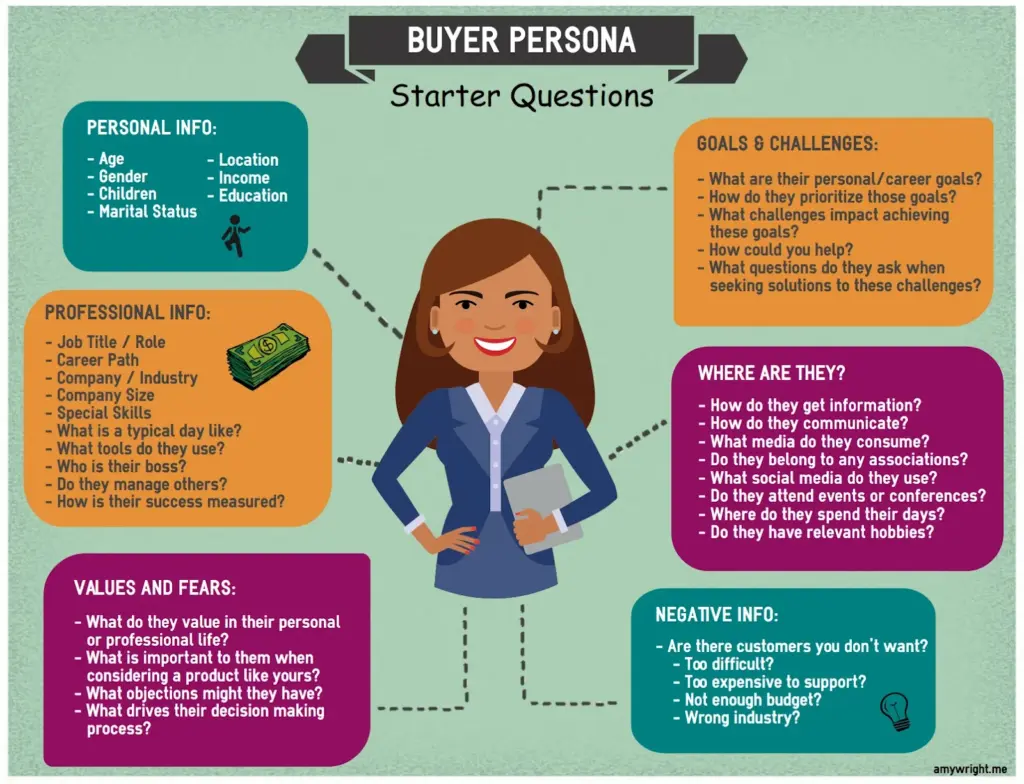
Create customer profiles: Develop detailed profiles for each segment, known as customer personas. Customer personas are fictional representations of your ideal customers within each segment. They help you understand the motivations, needs, and behaviours of your target audience. Each persona should include the following key elements:
a. Demographics: Include information such as age, gender, education, and job title.
b. Job-related information: Describe their roles, responsibilities, and challenges at work.
c. Goals and motivations: Understand what drives them professionally and what they aim to achieve.
d. Pain points and challenges: Identify the problems they face and the obstacles they encounter.
e. Preferences and behaviour: Consider their preferred communication channels, technology adoption, and decision-making processes.
f. Quotes and anecdotes: Use real quotes or stories gathered during your research to add depth and realism to the personas.
Give each persona a name: Assign a name to each persona to make them more relatable and memorable. For example, you might have personas like “Tech-Savvy Tom,” “Efficiency-Oriented Elena,” or “Data-Driven Dominic.”
How to use your personas
Use the personas in your marketing and product development: Incorporate the customer personas into your marketing strategies, product development, and decision-making processes. Align your messaging, content, and features with the specific needs and preferences of each persona. This will help you create targeted marketing campaigns, tailor your product offerings, and enhance the user experience.
Remember, customer personas are living documents that evolve over time as you gain more insights and refine your understanding of your target audience. Continuously validate and update your personas based on real-world feedback and data to ensure their accuracy and relevance.
Personas for the Indian market
An Indian audience often needs a wider persona than a Western playbook assumes. The person who uses your product is not always the person who pays for it, so a family or a committee can sit behind one decision. City tier, language preference and comfort with digital payments can change behaviour as much as job title does. Add those fields to your persona when the buyer and the user are different people.
Common questions
What is a customer persona?
A customer persona is a research-based profile of one type of ideal customer. It captures who they are, what they are trying to achieve, the problems in their way, and how they prefer to buy, so your team can design and sell for a real person instead of an average nobody meets.
How many personas should an early-stage startup have?
Start with one or two. Add a new persona only when the segment changes what you build or how you sell. A long list you never act on is worse than two you use every week.
Are personas just guesswork?
They should not be. Build them from interviews, surveys and real quotes, then keep updating them as you learn. A persona that never changes is a sign you stopped talking to customers.
Once your personas are clear, the next step is to pressure-test the plan behind them. Using customer feedback in product development shows how to close the loop, and our startup mentorship for Indian founders can help you sanity-check your assumptions.