Zepto’s business model is simple to describe and painful to fund: place groceries in small dark stores, accept orders through an app, pick them quickly, and deliver them in about 10 minutes. The money does not come from speed alone. It comes from product margins, delivery and platform fees, advertising paid by brands, private-label products, larger baskets, and enough orders per store to spread fixed costs. If those pieces do not work together, every extra order can increase your loss.
That is the part founders miss. Quick commerce is not a delivery business with a clever app. It is a dense retail and fulfilment operation wearing a technology costume.
What is Zepto’s business model?
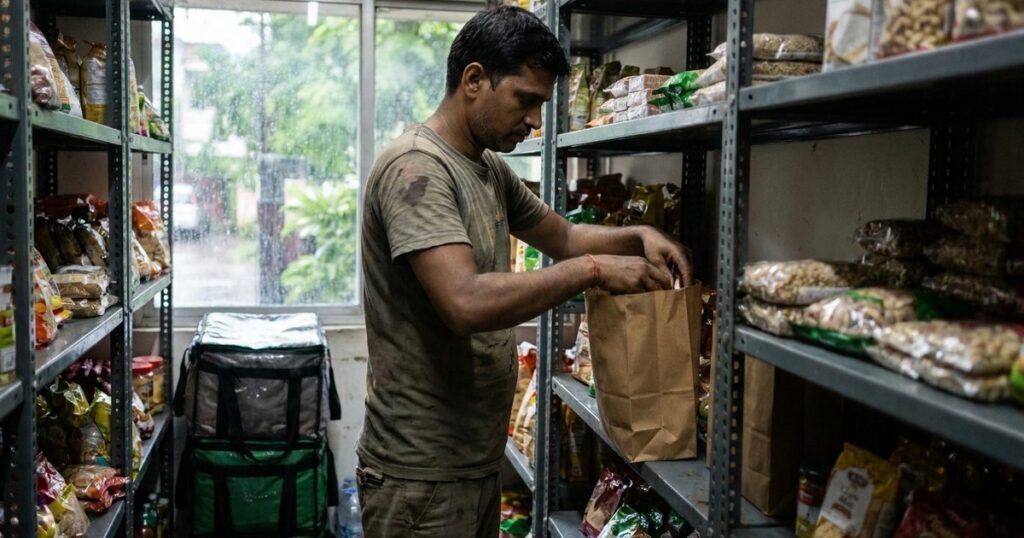
Zepto operates a quick-commerce marketplace and retail network. It places inventory close to customers in dark stores, sells groceries and daily-use products through its app, and fulfils orders using store staff and delivery partners.
The model has six moving parts:
- Dark stores: small, customer-inaccessible warehouses located close to dense residential demand.
- Inventory: groceries, fresh produce, personal care, household products, snacks and increasingly higher-margin categories.
- Customer orders: usually small baskets placed for convenience, urgency or habit.
- Picking and packing: store staff assemble the order within minutes.
- Last-mile delivery: a delivery partner takes the order over a short distance.
- Ancillary revenue: brand advertising, listing fees, delivery charges, subscriptions, private labels and other services.
Zepto may earn money from both goods and services. That distinction matters. Product sales create gross margin. Services such as advertising can carry much higher margins because they do not require another rider, warehouse or unit of inventory for every rupee earned.
The same broad model is used by Blinkit, Swiggy Instamart and newer quick-commerce offerings such as Flipkart Minutes. The fight is not over whether customers like 10-minute delivery. They clearly do in dense Indian neighbourhoods. The fight is over who can make each dark store economically productive before competitors force discounts and higher delivery payouts.
The scene that explains the entire business
A customer orders milk, bread and biscuits worth ₹220 at 9:30 pm. The dark store receives the order. A picker finds three items, packs them and hands the bag to a rider. The rider travels a short distance. The customer pays a small platform or delivery fee, or perhaps nothing at all.
Now ask the unfriendly question: how much money did that order create?
The retailer earns a gross margin on the products. Perhaps the basket has a blended product margin of 15% to 25%, depending on category and brand mix. On ₹220, that gives ₹33 to ₹55 before fulfilment costs.
The order still needs picking, packing, payment processing, shrinkage allowance, store rent, electricity, technology, customer support, rider payout, refunds and marketing allocation. The rider alone can consume a large part of the available contribution.
So the order can be useful to the customer and still be bad business.
This is why “10-minute delivery” is not the business model. It is the customer promise. The business model is the machinery required to make a dense cluster of orders produce enough contribution to cover the dark store and corporate overhead.
Investor rule: never call a quick-commerce order profitable until you have separated product gross margin, variable fulfilment cost, customer acquisition cost and the fixed cost of the store.
How Zepto makes money
1. Product margin
Zepto buys products from brands, distributors, wholesalers and other suppliers, then sells them to consumers. The difference between selling price and product cost is the gross margin.
Margins vary sharply:
| Category | Typical business reality | Why it matters |
|---|---|---|
| Milk, staples and packaged food | Lower margin, high frequency | Drives repeat orders but does little for contribution by itself |
| Snacks and beverages | Moderate margin, impulse-led | Raises basket size when merchandised well |
| Personal care and beauty | Often better margin | Improves blended economics |
| Fresh produce | Margin can be attractive, but wastage is a risk | Inventory discipline matters more than headline margin |
| Private-label products | Potentially higher gross margin | Requires demand forecasting, quality control and working capital |
Product margin is necessary. It is not sufficient. A 25% gross margin on a ₹250 basket gives you ₹62.50. That does not automatically cover delivery and store operations.
2. Delivery and platform fees
Customers may pay a delivery fee, small-order fee, surge fee or platform fee. These charges help, but they cannot carry the model on their own.
Push the fee too high and customers switch to Blinkit, Instamart, a nearby kirana or their next planned supermarket trip. Waive the fee too often and you train customers to wait for subsidies.
Fees should recover a meaningful part of variable fulfilment cost without destroying order frequency. That requires testing by neighbourhood, basket size, time of day and customer cohort. A single national fee policy is usually lazy management.
3. Advertising from brands
This is where the model becomes more interesting.
Brands want visibility inside the app. They may pay for search placement, banners, sponsored shelves, launch campaigns or preferential merchandising. A brand paying ₹1 lakh for a campaign does not require a separate delivery trip for every rupee of revenue. That makes advertising far more attractive than selling another low-margin packet of biscuits.
But advertising revenue has a limit. If you bury organic search results under paid placements, customers lose trust. If you sell visibility to a brand with poor availability, you create a bad customer experience. If your sales team counts every promotional rupee as recurring revenue, your forecast becomes fiction.
Track advertising separately from retail operations. Report:
- advertising revenue per order;
- advertising revenue per active customer;
- repeat purchase after a sponsored campaign;
- incremental sales versus sales that would have happened anyway;
- gross margin after discounts funded by the brand.
4. Private labels
Private labels can improve gross margin and give the platform more control over assortment. They also create new problems: product development, quality failures, regulatory compliance, packaging, working capital and customer trust.
A private label should not exist because the margin looks attractive in a spreadsheet. It should exist because you have repeated demand, a clear quality advantage or a category where brands are overpriced.
Start with a narrow range. Measure repeat purchase, complaints, refunds, expiry and contribution after wastage. Do not launch 300 products because a consultant told you that private labels are the path to profitability.
5. Subscriptions and loyalty
A subscription can reduce fee sensitivity and increase order frequency. It can also become another discount disguised as retention.
The right question is not, “How many users bought the membership?” Ask:
- Did order frequency rise?
- Did the customer’s contribution after discounts improve?
- Did churn fall after the subscription ended?
- Did members place larger baskets or merely claim cheaper delivery?
Retention is valuable only when the retained customer produces contribution. A loyal loss-maker is still a loss-maker.
Why dark stores are the heart of the Zepto model
A dark store is a small warehouse placed close to demand. Customers do not walk in. Staff pick orders from shelves designed for speed, not browsing.
The store solves the biggest problem in grocery delivery: distance. A central warehouse can carry more inventory, but it cannot deliver quickly to every neighbourhood. A network of local stores reduces delivery distance and time.
It also creates a heavy fixed-cost burden.
Each store needs rent, deposits, fit-out, refrigeration where required, staff, utilities, security, inventory and local management. The store must process enough orders every day to spread those costs.
Store density creates a trade-off:
- Too few stores: delivery distances rise and the 10-minute promise breaks.
- Too many stores: each store receives too few orders and fixed cost per order explodes.
- Stores too large: rent and inventory rise before demand is proven.
- Stores too small: stock-outs and poor assortment reduce conversion.
This is a local density problem, not a national scale problem. A company can report millions of orders and still lose money in weak micro-markets.
The metric that matters: orders per store per day
Founders love reporting total orders. Investors should ask for orders per store per day, by city and by store cohort.
Suppose a store has monthly fixed costs of ₹12 lakh. At 1,000 orders per day, fixed cost is roughly ₹40 per order. At 500 orders per day, it is roughly ₹80. The same basket and the same rider payout now produce a very different result.
That is why opening stores can make a company look bigger while making its P&L worse.
Before opening a new store, define a ramp plan:
- Map households, offices and existing order density in the proposed catchment.
- Estimate realistic orders per day without assuming heavy discounts.
- Model rent, staff, shrinkage, wastage, electricity and delivery cost.
- Set a breakeven order threshold and a deadline for reaching it.
- Close, relocate or resize the store if the threshold is missed.
Founders often treat store closure as failure. It is not. Keeping a structurally weak store open because you are emotionally attached to the expansion plan is failure.
The unit economics: where the money actually goes
Use a contribution model, not a vanity revenue model.
A basic order-level formula is:
Contribution per order = product gross profit + customer fees + advertising allocation − delivery cost − picking and packing − payment cost − refunds and wastage − variable discounts.
Then calculate store-level contribution:
Store contribution = contribution per order × orders − store fixed costs.
Only after that should you allocate central technology, corporate salaries, finance, legal, brand marketing and fundraising costs.
Public disclosures and filing analyses show why the distinction matters. Reports based on Zepto’s updated IPO filing have estimated average delivery cost at roughly ₹45.74 per order in FY26 and variable supply-chain cost at about ₹61.24 per order in the March 2026 quarter. The reported total cost per order, including broader operating costs, was approximately ₹127.79 for that quarter. See the reporting by The Hindu BusinessLine and The Economic Times.
These figures are not a universal direct cost for every order. They include different cost buckets and accounting treatments. Use them as a warning, not as a plug-and-play benchmark for your own model.
The lesson is mechanical: a ₹200 basket cannot support a ₹127 total cost unless margin, fees, advertising and repeat behaviour do a lot of work.
Do not celebrate gross merchandise value. A large GMV number with weak contribution per order is simply a larger machine for converting capital into losses.
Why speed alone does not create a moat
Ten minutes sounds defensible until every serious competitor promises a similar time. Speed then becomes a price of entry.
The stronger advantages are operational:
- better demand forecasting;
- higher in-stock rates;
- lower wastage;
- more orders per store;
- shorter average delivery distance;
- better picking productivity;
- stronger brand advertising demand;
- higher customer retention without discounts.
A competitor can copy your delivery promise. It cannot instantly copy a dense, profitable network with good inventory data and strong supplier terms.
That is also why quick commerce may expand beyond emergency groceries. Electronics accessories, beauty products, pet supplies, pharmacy-adjacent categories where permitted, and small household items can raise basket size. But every category adds inventory complexity. Expansion is useful only when the added category improves contribution without damaging availability in the core range.
Customer acquisition is where founders lie to themselves
Quick-commerce companies spend heavily to acquire and reactivate customers. Discounts, referral credits, free delivery and brand campaigns can make early cohorts look healthy.
You need cohort-level answers:
- What is the first-order CAC?
- How many orders arrive in the next 30, 60 and 90 days?
- What is contribution after all discounts?
- How much of the repeat behaviour survives when incentives stop?
- Does the customer order from one store or move between catchments?
Calculate payback honestly:
Payback period = fully loaded CAC ÷ monthly contribution from the customer.
If CAC is ₹300 and monthly contribution is ₹50, payback takes six months before churn. If the customer disappears after four months, the cohort is unprofitable even if revenue looks impressive.
Do not put brand advertising funded by suppliers into customer contribution unless you can prove it is repeatable and incremental. Do not exclude refunds because they are “one-off”. Do not exclude discount-funded orders because they are “marketing”. Your customer will not care about your accounting story when the cash leaves the bank.
For a useful framework, compare your operating metric with the advice in this guide on choosing a North Star metric. For quick commerce, orders alone are a poor North Star. A better candidate is contribution per active customer or store contribution after variable fulfilment costs.
What founders building a Zepto-like business get wrong
They start with the app
The app is not the hard part. A competent Indian product team can build catalogue, payments, order tracking and delivery workflows. The hard part is deciding what to stock, where to stock it, how much to buy and when to stop serving a weak zone.
They promise 10 minutes everywhere
Do not make a city-wide promise before you understand neighbourhood density. Start with a small catchment. Prove repeat demand. Then add stores.
They confuse convenience with willingness to pay
Customers may love fast delivery and still refuse to pay enough for it. Measure actual fee acceptance. Do not infer willingness to pay from app engagement.
They ignore stock-outs
A customer who cannot find milk, bread or the preferred brand will switch quickly. Availability is a revenue metric. Track lost sales from stock-outs by SKU and store.
They treat discounts as retention
Discount-led frequency is rented demand. Test retention after incentives are removed.
They expand before store economics mature
Fundraising creates pressure to show growth. That pressure causes premature city launches. A new city with weak density consumes cash and distracts the team from fixing the first market.
A practical launch plan for a Zepto-like startup
If you are building in this category, do not begin with 100 stores. Begin with one tight operating zone.
- Choose a narrow customer use case. Target urgent top-ups, late-night needs, office clusters or a specific category. “Everything for everyone” is not a wedge.
- Run a manual pilot. Use a small rented space and a limited catalogue. Learn demand before buying expensive inventory and software.
- Measure real order economics. Include rider payout, picker wages, wastage, refunds, payment charges, discounts and local marketing.
- Test basket expansion. Use bundles and merchandising rather than blanket discounts. Track whether the customer adds profitable items.
- Set a store breakeven threshold. Decide in advance the order volume and contribution required to keep the location open.
- Build supplier relationships. Better payment terms and reliable replenishment can matter more than another app feature.
- Expand only after repeat demand. A store should show repeat customers, acceptable stock-outs and improving contribution before you duplicate it.
Your first fundraise should buy learning and a credible operating wedge. It should not finance a city-wide land grab because your pitch deck has a large total addressable market.
How investors should evaluate the Zepto business model
If you are raising a seed or pre-Series A round for quick commerce, expect serious investors to ask questions that do not appear in your growth slide.
- What is contribution per order before and after advertising revenue?
- What percentage of orders receive discounts?
- What is the average basket value by cohort?
- What are orders per store per day by store age?
- How many stores are contribution-positive?
- What is the median delivery distance?
- What is the rider cost at peak and off-peak hours?
- What is the stock-out rate for the top 100 SKUs?
- How much inventory is expired, damaged or written off?
- What happens to retention when discounts fall by 25%?
- How much revenue comes from advertising, and is it incremental?
- What is the cash conversion cycle with suppliers?
Investors will also examine your cap table and runway. A business with negative contribution and a short cash runway becomes dependent on the next round. That is a dangerous position in the Indian seed-to-Series-A funnel. Read the implications of dilution carefully before signing a term sheet; this guide on pre-money versus post-money valuation covers a common mistake founders make when optimising only for headline valuation.
Is Zepto’s model profitable?
The honest answer is not a slogan. Profitability depends on the level at which you measure it.
A store may be contribution-positive while the company remains loss-making because corporate costs, expansion, technology and customer acquisition consume cash. A company may report positive adjusted EBITDA while still requiring substantial working capital and expansion funding. A product category may be profitable while the average order is not.
Recent financial reporting has shown the sector moving toward better adjusted profitability at scale, while individual businesses still carry large losses and expansion costs. Eternal, the parent of Zomato and Blinkit, has reported improving consolidated adjusted EBITDA and positive adjusted EBITDA for Blinkit in later disclosures; its shareholder letters are available on the Eternal website. Those numbers prove that dense operations can improve. They do not prove that every store, order or competitor has good economics.
Do not copy a large public company’s endpoint and ignore the years of capital, density and operational learning required to get there.
What you should do this week
If you are building a quick-commerce or local delivery startup, spend the next seven days on a brutally narrow analysis.
- Export every order from the last 30 days.
- Calculate contribution per order using actual costs, not budget assumptions.
- Split customers into first order, repeat order and high-frequency cohorts.
- Rank every store or delivery zone by orders, basket value and contribution.
- Remove discounts from the model and calculate the damage.
- Identify the top 20 SKUs causing stock-outs or wastage.
- Pause expansion until one zone meets your written breakeven conditions.
If you cannot produce this analysis from your own systems, you are not ready to raise a large round. You are ready to install better reporting.
The bottom line
Zepto’s business model is not “deliver groceries in 10 minutes.” That is the visible promise. The economic engine is a high-density retail network where each store processes enough orders, each basket carries enough margin, each delivery costs little enough, and advertising or private labels add revenue without adding equal fulfilment cost.
Speed gets the first order. Density, repeat behaviour and contribution keep the company alive.
If your plan depends on customers ordering small baskets, refusing delivery fees, accepting constant discounts and somehow producing profit later, you do not have a business model. You have a funding requirement.
FAQs
What is Zepto’s business model?
Zepto uses a quick-commerce model built on dark stores, owned or managed inventory, app-based ordering and short-distance delivery. Revenue comes from product margins, customer fees, advertising, private labels and related services.
How does Zepto make money from 10-minute delivery?
It does not make money from speed alone. It combines product gross margin with delivery or platform fees, brand advertising, larger baskets, private-label products and high order density per dark store.
What is a dark store in quick commerce?
A dark store is a small warehouse near residential demand. Customers cannot shop inside it. Store staff pick and pack online orders for delivery.
Why does quick commerce lose money on small orders?
A small order produces limited product gross profit but still requires picking, packing, delivery, payment processing, inventory handling and customer support. Unless fees, advertising or repeat purchases cover those costs, the order loses money.
What are the main costs in Zepto’s business model?
The major costs include inventory procurement, rider payouts, picker wages, dark-store rent, electricity, wastage, refunds, technology, customer acquisition, discounts and corporate overhead.
Is Zepto profitable?
Profitability must be judged by level. A particular store or cohort may be contribution-positive while the company remains loss-making because of expansion and central costs. Public filings and company disclosures should be read carefully because adjusted EBITDA, store contribution and net profit are different measures.
How much does it cost to start a Zepto-like business in India?
There is no honest single number. Your cost depends on city, rent, inventory range, store size, delivery radius, staffing and customer acquisition. A small pilot can be run with far less capital than a multi-store launch, but a serious network requires substantial working capital and operating cash.
What metric matters most in a quick-commerce startup?
Track contribution per order and contribution per active customer, then connect them to orders per store per day. Total orders and GMV are incomplete metrics because they can grow while losses grow faster.
Should a founder build a Zepto-like app?
Only if you have a specific local advantage: dense demand, a differentiated category, better supply, lower fulfilment cost or a customer segment incumbents serve poorly. Building another general grocery app with discounts is not a strategy.
Founders who want hands-on feedback on unit economics, capital planning and the seed-to-Series-A path can reach out to Malpani Ventures.