
Part 7 of 40 in The Crorepati’s Shoestring← Part 6Part 8 →
The Crorepati's Shoestring examines how founders can use small, measurable experiments to learn what customers value and what an idea costs to deliver. It helps Indian founders test assumptions before spending heavily on tools, consultants, hiring or branding.
- A useful experiment produces information rather than making the company look impressive.
- Choose the one hypothesis that could kill the idea and test it with the smallest reversible decision.
- A seven-day pre-order test can measure deposits, cancellations and gross contribution within a capped ₹10,000 budget.
- Observe customers, deliver personally, count all direct costs, change one variable and decide whether to continue, modify or stop.
- AI can help draft test protocols and results sheets, but people must verify assumptions and review important decisions.
The central argument
An experiment should buy information, not theatre.
There is a temptation in the Indian startup ecosystem to turn an uncertainty into a capital request. The founder has not yet learned what the buyer values, how the product will be delivered, or how much it costs to fulfil one promise. A cheque may postpone these questions, but it rarely answers them. The better starting point is a test that forces reality to respond.
Frugality is not miserliness. It is disciplined resource allocation. Spend generously where quality, safety, trust or the customer outcome requires it; challenge spending that merely makes the company look more impressive. This distinction matters in an economy where an extra month of runway, an advance payment, or an honest conversation with a buyer can change a company’s future.
The practical decision in this chapter is specific: name the one hypothesis that could kill the idea. It asks the founder to trade certainty of appearance for evidence of substance. Evidence may be awkward, disappointing or slower than a press announcement; it is still more useful.
Questions worth asking
- What would I have to observe to know that “an experiment should buy information, not theatre.” applies here?
- What is the smallest reversible choice I can make this week?
- Which customer, worker or supplier knows something my spreadsheet does not?
Founder’s margin note: Describe the decision you have postponed because you hoped funding, hiring or a new tool would make it easier.
An Indian story
ILLUSTRATIVE COMPOSITE, a teaching scenario, not a documented account of a named company.
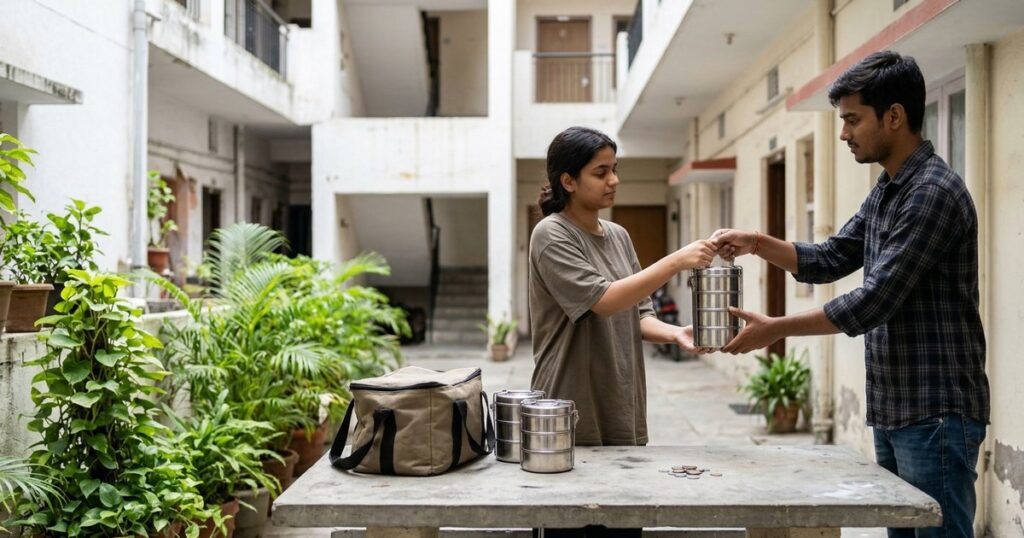
A student in Indore tests a tiffin subscription by collecting advance payments at two hostels.
Imagine meeting this founder on a hot afternoon with three phone calls missed and a supplier waiting for an answer. The problem is not a shortage of ideas. It is a shortage of clear priorities. The founder can buy a tool, hire a consultant or redesign the logo, but none of those actions will automatically uncover the customer’s actual need.
Instead, the founder chooses a modest, observable next step: run a seven-day pre-order test with a capped ₹10,000 budget. The purpose is not to win a case-study competition. It is to discover whether people change their behaviour when the offer is made, and what the economics look like after the founder does the work.
The signal to watch is deposits, cancellations and gross contribution. A disappointing result is useful when it rules out an expensive path. A promising result is only a beginning: repeat it with customers who do not know you personally, on ordinary weekdays, without special favours.
Compare with documented Indian founders
The lesson should be tested in your own market rather than borrowed unquestioningly from a celebrated startup. A founder supplying small-town retailers faces different margins, credit terms and trust barriers from a software exporter. Copy a method of learning, not a famous company’s surface features.
Field observation: Who in your district or industry already does this unusually well with limited resources? Ask permission to observe them.
The operating playbook
A seven-day field experiment
Day 1, Define Write the most dangerous assumption behind this chapter: An experiment should buy information, not theatre. Name who could prove you wrong.
Day 2, Observe Watch three customers perform the task today; record actions and exact phrases, not your interpretation.
Day 3, Offer Make a concrete offer or test: Run a seven-day pre-order test with a capped ₹10,000 budget. Be clear about price, terms and expected delivery.
Day 4, Deliver Personally perform the least scalable part. Observe friction, mistakes and objections before automating.
Day 5, Count Measure deposits, cancellations and gross contribution; include time, cash paid, refunds and all direct costs.
Day 6, Repair Look specifically for this trap: changing five variables at once. Change one thing, not the entire system.
Day 7, Decide Continue, modify or stop. State what evidence would reverse your decision next week.
The one-page scorecard
Hypothesis and customer segment: ______________________________
Cash spent / cash collected / money still owed: ____________________
Outcome metric and its baseline: ________________________________
Three observations that surprised us: ____________________________
Decision, owner and date of next review: _________________________
Rule: a failed test is acceptable; an unmeasured test is merely activity.
AI workshop & reflection
What to delegate to AI
Draft a simple test protocol and an unbiased results sheet.
Copy-ready founder prompt
Act as a skeptical operating partner to an Indian bootstrapped startup. Our chapter principle is: “An experiment should buy information, not theatre.” Our target customer is [segment], budget is ₹[amount], and our available time is [days]. We are considering this experiment: Run a seven-day pre-order test with a capped ₹10,000 budget. Identify hidden assumptions, a cheaper test, what evidence would disprove the idea, relevant India-specific customer frictions, and a quality checklist. Do not invent customer facts. Mark every assumption requiring human verification.
Check the output before acting
- Are all numbers sourced from my own records or clearly labelled assumptions?
- Have we checked local language, payment habits and distribution realities?
- Have we excluded customer identifiers and confidential commercial information?
- Does a human owner review any safety, legal, financial or reputational decision?
Your founder notebook
One belief I am willing to change: ________________________________
One real customer I will speak to: ________________________________
One experiment I will complete: ________________________________
My follow-up date: ________________________________
The point of AI is not to sound more certain. It is to become cheaper, quicker and more rigorous at discovering what is true.
Frequently asked questions
What makes an experiment useful for a startup?
It should produce evidence about what customers value, how delivery works or what fulfilling one promise costs. The test should buy information rather than theatre.
How can I test a tiffin subscription with ₹10,000?
Run a seven-day pre-order test with a capped ₹10,000 budget. Measure deposits, cancellations and gross contribution, including time, cash paid, refunds and direct costs.
What should I measure in a seven-day field experiment?
Watch customer actions and exact phrases, then measure deposits, cancellations and gross contribution. Record cash spent, cash collected, money owed and three surprising observations.
How should AI be used in this experiment?
AI can draft a simple test protocol and unbiased results sheet, identify hidden assumptions and suggest a cheaper test. Check its output, verify local realities and exclude customer identifiers and confidential information.