
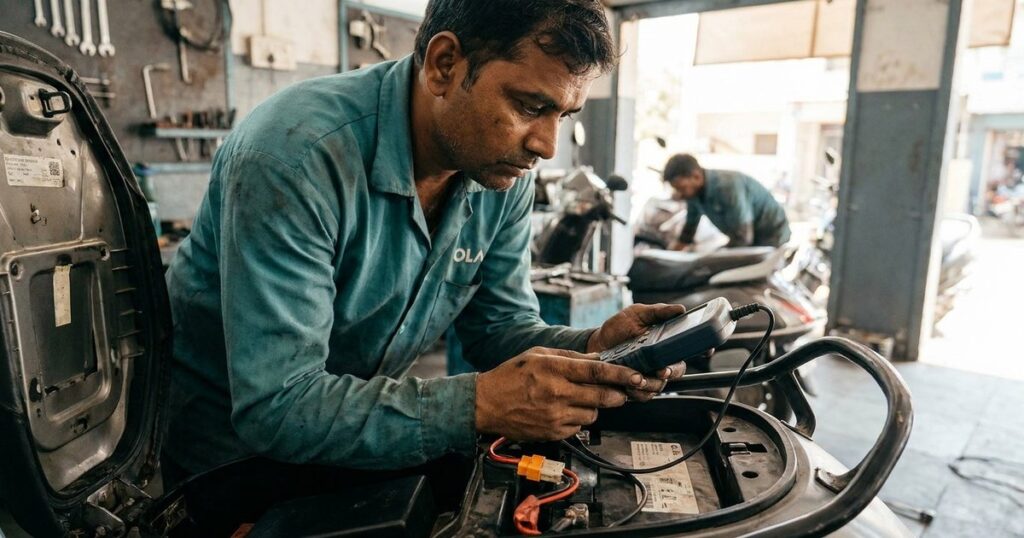
Ola Electric’s business model is simple on paper: design electric scooters, sell them directly to Indian consumers, earn from the vehicle and software, and build a dense service network around the installed base. The hard part is not selling scooters. It is servicing hundreds of thousands of them without destroying trust, margins, or cash flow. Ola showed Indian founders the danger of confusing distribution scale with operating maturity.
Public reporting in 2024 put Ola Electric’s cumulative sales above three lakh scooters. That is serious distribution. But reviews sampled across Bengaluru and Hyderabad service locations showed a very different picture: ratings around 1.9 to 2.5, positive sentiment as low as 5-10%, and NPS as low as -88 in some locations. These are not merely angry customers on social media. They are signals from the part of the business that decides whether your next sale gets cheaper or costlier.
Ola Electric business model: how it was meant to work
Ola Electric tried to control more of the value chain than a traditional two-wheeler company. Its model combined five pieces:
- Product design: electric scooters, batteries, motors, electronics and software under one brand.
- Direct sales: online-led ordering and company-controlled customer acquisition rather than a conventional dealer network.
- Manufacturing: large-scale production, centred on the Ola Futurefactory in Tamil Nadu.
- Software and connected features: the scooter was positioned as a connected product, not just a motor and frame.
- Service infrastructure: company-owned or company-controlled service points intended to support the installed base.
That model has an obvious attraction. You remove dealer margins, own the customer relationship, collect product data, control pricing, and potentially earn additional revenue from financing, accessories, subscriptions and future software features.
It also creates a nasty obligation: you own every failure in the customer journey.
A conventional dealer can absorb some sales friction. A large service network can handle local repairs. A mature incumbent has years of parts forecasting, technician training and warranty data. A direct-to-consumer startup gets the upside of control, but also gets blamed directly when a scooter does not start, a replacement part is unavailable, or a customer cannot get a clear repair date.
The investor’s reading of Ola’s scale
Founders often look at a sales chart and see proof of product-market fit. Investors look for the cost of supporting every unit after sale.
Suppose you sell 300,000 vehicles. That is not one achievement. It is a growing liability ledger:
- 300,000 batteries that may need diagnosis or replacement.
- 300,000 sets of brakes, tyres, suspension components and electronics.
- Thousands of daily service interactions.
- Warranty claims that must be approved, repaired and paid for.
- Spare parts that must sit in the right city before the customer arrives.
- Technicians who must understand both mechanical systems and high-voltage electronics.
- Software updates that can create new support tickets at national scale.
Your unit economics are incomplete if they stop at gross margin on the first sale. The real contribution calculation is closer to:
Net contribution per vehicle = selling price − bill of materials − manufacturing − logistics − acquisition cost − warranty reserve − service cost − refunds and goodwill credits.
If you do not know the last three numbers, you do not know whether you have a business. You have a shipment count.
Sales scale without service capacity is deferred customer acquisition cost. Every unresolved complaint makes the next customer more expensive.
Why the service backlash matters more than a bad review score
A low Google rating is not the main problem. The main problem is what produced it.
Customer complaints across the reviewed Ola locations repeatedly centred on:
- Long waiting times.
- Unclear repair schedules.
- Weak communication during the repair cycle.
- Parts not being available.
- Staff who could not explain the fault or the next step.
- Battery, software and build-quality concerns.
The pattern matters. If complaints were limited to one technician or one branch, you could replace the person. When similar complaints appear across cities, suspect the operating system:
- No standard repair-time targets.
- Poor parts allocation.
- Weak escalation rules.
- Insufficient technician training.
- No single owner for the customer case.
- Service centres opened before the supply chain was ready.
This is the difference between a people problem and a process problem. Founders routinely fire frontline employees for a process they never designed. That gives you a temporary scapegoat and no improvement.
The service journey is where trust collapses
The customer journey has five broad stages:
| Stage | Customer question | Metric you should track | Typical failure |
|---|---|---|---|
| Discovery | Is this product credible? | Qualified lead to test ride | Overpromising range or features |
| Purchase | Will delivery happen as promised? | Order-to-delivery time | Unclear timelines and cancellations |
| Usage | Does the product work every day? | 30-day active usage and fault rate | Software, battery or build issues |
| Service | Will someone fix it quickly? | First-time fix rate and turnaround time | Repeat visits and unavailable parts |
| Advocacy | Would I recommend it? | NPS by service outcome | Public complaints and referrals falling |
The sharpest sentiment drop usually happens after purchase, when the customer has no longer got a sales executive chasing the transaction. That is when your brand promise meets your operations.
A customer will forgive a defect more readily than silence. If the repair takes five days and you say so on day one, the customer can plan. If you promise tomorrow for two weeks, you turn a repair into betrayal.
Ola’s direct-to-consumer bet: the upside and the bill
Direct sales are attractive because they promise better control. You can test pricing, collect first-party data, control the pitch and avoid dealer commissions. For a startup, that can look like a clean path to higher gross margin.
But direct sales also remove buffers. A dealer normally handles local discovery, test rides, delivery coordination, minor service and some customer anger. If you remove that layer, you must replace each function with people, software and physical infrastructure.
That replacement costs money before revenue arrives.
What direct ownership gives you
- Direct access to customer behaviour and product complaints.
- Control over pricing and promotions.
- Faster product feedback loops.
- Potentially better economics once service density is high.
- A single brand experience across locations.
What it forces you to build
- Call-centre capacity.
- Appointment and queue management.
- Spare-parts forecasting.
- Warranty adjudication.
- Technician hiring and certification.
- Reverse logistics for damaged components.
- Escalation and refund policies.
Most early-stage founders budget for the first list and quietly assume the second list will emerge later. It will not. Operations do not appear because your pitch deck says “asset-light”.
The manufacturing trap: capacity is not throughput
Large factories create impressive headlines. They do not automatically create reliable products.
Manufacturing has at least four separate constraints:
- Design maturity: the product must be stable enough for repeatable production.
- Supplier quality: cells, controllers, displays, wiring and mechanical parts must meet specification consistently.
- Process control: assembly, testing and end-of-line checks must catch defects.
- Field feedback: failures must return quickly to engineering and supplier teams.
If you increase output before these systems are ready, you do not create scale. You multiply defects.
This is especially dangerous for electric vehicles. A small issue in a screen or app is irritating. A battery, thermal, motor-controller or charging problem can immobilise the vehicle, create safety anxiety and require specialist repair.
Your factory dashboard may show units produced per shift. Your customer dashboard must show:
- First 90-day failure rate.
- Warranty claims per 1,000 vehicles.
- Repeat repair rate.
- Mean time to diagnose.
- Mean time to repair.
- Parts fill rate.
- Vehicles waiting for parts.
- Customer complaints older than 48 hours.
If the second dashboard worsens while the first improves, slow production. That is not weakness. It is capital discipline.
Why software does not rescue weak hardware service
Ola positioned its scooters as software-led products. Connected dashboards, app controls and over-the-air updates can improve the experience. They can also create a dangerous founder illusion: that every problem can be fixed remotely.
Software can change a setting. It cannot replace a missing brake component. It cannot repair a damaged battery pack. It cannot train a technician who does not understand the fault tree.
Connected products need two operating loops:
- Remote loop: detect, diagnose, communicate and resolve software or configuration problems.
- Physical loop: inspect, stock parts, repair, test and return the vehicle.
The remote loop is cheaper, so founders overinvest in it. The physical loop is where customers judge you. Your service app is not service. A ticket number is not ownership.
What Ola’s service data teaches you about customer experience
A review sample covering 50-plus Bengaluru reviews reported roughly 75% negative, 15% neutral and 10% positive sentiment. Other sampled locations showed average ratings around 1.9 to 2.5, with positive sentiment sometimes near 5% and NPS as low as -88. The sample is not a full audited customer database, so do not treat it as a national failure rate. Treat it as an operational alarm.
Reviews have selection bias. Angry customers post more often. But repeated themes across multiple locations are hard to dismiss. A founder who says “online reviews are noisy” may be technically correct and commercially foolish.
Review data is useful when you convert it into operational questions:
- How many complaints mention the same part?
- How many cases exceed the promised turnaround time?
- How many customers return twice for the same fault?
- How many complaints lack a named owner?
- How many cases were closed without customer confirmation?
- Which service centres have high volume but low first-time fix rates?
Do not chase a higher rating as a vanity metric. Reduce the causes that produce the rating.
The unit economics founders should steal from this case
Before you expand, build a location-level service model. Use actual Indian costs, not a consultant’s generic assumptions.
| Cost line | Questions to answer | Warning signal |
|---|---|---|
| Rent and fit-out | How many vehicles per day cover fixed cost? | Centre opened before local demand exists |
| Technicians | How many jobs can each technician complete safely? | Overtime and repeat repairs rising |
| Parts | What is the fill rate for top 20 failure parts? | Vehicles parked while customers wait |
| Warranty | What reserve is held per vehicle sold? | Claims exceed the reserve every quarter |
| Customer support | How many cases can one agent close properly? | Tickets closed without resolution |
| Logistics | What is the cost of moving parts and vehicles? | Ad hoc courier and towing bills |
For a service centre, calculate:
Break-even jobs per month = monthly fixed cost ÷ contribution per completed job.
For the installed base, calculate:
Required monthly capacity = active vehicles × monthly service incidence × average technician hours per job.
Then add a peak factor. Indian service demand is not evenly distributed. Monsoon damage, festival travel, heat, software releases and battery complaints can create sudden spikes. If your model works only at average demand, it does not work.
What Ola should have measured before opening more centres
The wrong expansion question is: “How many service centres can we launch this quarter?”
The right question is: “What service load can each centre absorb while keeping promised turnaround time?”
A practical gate would include:
- Parts readiness: stock the failure-prone parts for the next 60-90 days, based on field data rather than a generic bill of materials.
- Technician certification: test technicians on diagnosis, high-voltage safety and first-time repair, not just attendance in a training room.
- Capacity buffer: keep at least 20-30% spare daily capacity for urgent cases and demand spikes.
- Customer ownership: assign one person to every vehicle and give the customer a dated next update.
- Escalation: define what happens when a repair crosses 24, 48 and 72 hours.
- Quality gate: delay expansion if repeat repairs or parts-related waiting time rises for two consecutive reporting periods.
The exact thresholds will vary by product. The principle will not: expand service capacity before sales capacity forces you to.
What this means for your startup
You may not sell scooters. You may run a healthtech clinic, a D2C appliance brand, a B2B marketplace or a fintech product. The same failure pattern appears whenever you scale acquisition faster than fulfilment.
Ask yourself:
- What promise does your sales team make that operations cannot yet deliver?
- Which customer complaint repeats across cities?
- What percentage of support tickets require a second interaction?
- What is your backlog in days, not tickets?
- What does one unhappy customer cost in refunds, support hours and lost referrals?
- Are you measuring gross sales while hiding warranty, returns or service costs below the line?
For a seed-stage company, this matters even more. You do not have the balance sheet to buy forgiveness. A large incumbent can spend years repairing trust. You cannot.
The one exercise to complete this week
Take your last 100 customer complaints. Put each into one of five buckets: product defect, delivery failure, support delay, communication failure or pricing/payment issue. Then calculate:
- Share of complaints in each bucket.
- Median time to resolution.
- Repeat-contact rate.
- Refund or compensation paid.
- Revenue or referral lost after the complaint.
Now pick the largest bucket and assign one owner with a 14-day target. Not a committee. Not “customer success” as an abstract department. One person. One metric. One deadline.
If you cannot do this because your support data is scattered across WhatsApp, spreadsheets and personal phones, your first operations hire is not another salesperson. It is someone who can build a reliable case-management system.
Fundraising implications: investors will ask about the hidden liability
At seed stage, founders often present gross margin and monthly sales. Sophisticated investors will ask what happens after the sale.
Expect questions such as:
- What is warranty cost per unit?
- How many customers contact support in the first 30 days?
- What is the repeat complaint rate?
- How much service capacity exists per 1,000 active customers?
- What is the cash conversion cycle after returns and refunds?
- Which costs are capitalised rather than expensed?
- How much of the current margin disappears when you provision honestly?
Do not hide behind adjusted metrics. Show a bridge from invoice value to cash contribution. If your service model is immature, say so and show the plan. Investors can fund a known operational gap. They will punish a founder who discovers it after spending the round.
When you prepare your next fundraise, use the pre-fundraise checklist for Indian founders and add a service-quality appendix. If your business has physical fulfilment, this appendix is not optional.
Can Ola Electric recover?
Yes, but not by launching another headline product or cutting the service queue with temporary discounts.
Recovery requires boring work:
- Publish realistic repair timelines.
- Stock parts according to actual failure data.
- Train and certify technicians.
- Separate software incidents from hardware repairs.
- Track first-time fix rate by centre.
- Give customers a named owner.
- Compensate customers when the company misses a written promise.
- Feed service failures back into product and supplier decisions.
The company must also decide how much control it truly needs. A fully owned network gives control but consumes capital and management attention. A partner network may increase reach but requires audits, training, parts discipline and incentives. The answer is not ideological. Compare the cost of each model per successfully resolved case.
| Model | Advantage | Risk | Best use |
|---|---|---|---|
| Company-owned centres | More control over training and customer data | High fixed cost and slow rollout | Complex repairs and flagship cities |
| Authorised partners | Faster geographic reach | Inconsistent quality and incentives | Routine repairs with strict audits |
| Mobile service | Lower customer travel and faster minor fixes | Limited equipment and technician productivity | Diagnostics and low-complexity jobs |
| Central repair hubs | Deep technical capability | Transport delays and poor local convenience | Battery and major component repairs |
Do not choose a model because it sounds asset-light. Choose it because it meets a promised turnaround time at a cost your gross margin can support.
Bottom line
Ola Electric’s central lesson is not that electric scooters are difficult to sell. It is that a product company becomes a service company the moment customers start depending on it.
Three lakh vehicles sold can be a distribution victory or a three-lakh-unit support obligation. The difference is your parts supply, technician productivity, warranty reserve, communication discipline and first-time fix rate.
If you are building in India, do not show investors only how fast you acquire customers. Show how cheaply and reliably you keep them successful. The company that sells fastest is not necessarily winning. The company that resolves failure without burning its margin is.
Founders who want a hard review of their operating model, unit economics and fundraise readiness can reach out to Malpani Ventures as a mentor-investor.
FAQs
What is Ola Electric’s business model?
Ola Electric designs and sells electric scooters, primarily through a direct-to-consumer model. It also aims to earn through software, accessories, financing and after-sales services while controlling manufacturing and customer support.
How does Ola Electric make money?
Its main revenue comes from electric scooter sales. Additional revenue may come from accessories, financing partnerships, software-linked features and service-related offerings. The quality of the model depends on contribution after warranty, support and repair costs.
Why has Ola Electric faced service criticism?
Customer complaints have repeatedly mentioned delayed repairs, unavailable parts, poor communication, software and battery issues, and inconsistent service-centre execution. Repeated complaints across locations suggest operating-process gaps, not only isolated employee mistakes.
Is Ola Electric profitable?
Profitability cannot be judged from vehicle sales alone. You must examine gross margin, warranty provisions, service costs, customer acquisition, manufacturing expenses and cash burn. Publicly reported financial performance should be checked against the company’s latest filings and disclosures.
What should an EV startup measure after selling a vehicle?
Track warranty claims per 1,000 vehicles, first-time fix rate, mean time to diagnose, mean time to repair, parts fill rate, repeat repair rate, support backlog and customer satisfaction after resolution.
Should startups build their own service network?
Only when service quality is central to retention and the company can afford the fixed cost. Compare company-owned, partner, mobile and central-hub models using cost per resolved case and promised turnaround time.
What is the biggest lesson for Indian startup founders?
Do not scale customer acquisition faster than fulfilment and support. A customer acquired today creates a future service, refund, warranty or support obligation. Include that obligation in your unit economics before you raise or expand.