Lenskart’s business model is not “selling glasses online”. It is a vertically integrated, omnichannel eyewear retail business: stores acquire trust and customers, the app captures repeat purchases, private labels protect gross margin, and owned manufacturing improves speed and control. The website was the entry point. The real business is the operating system connecting factories, stores, prescriptions, inventory and customer data.
That distinction matters if you are building an Indian consumer startup. Lenskart did not win by forcing Indian customers to behave like American e-commerce customers. It changed the model when the market refused to cooperate.
Lenskart business model: the short answer
Lenskart makes money by selling prescription spectacles, sunglasses, contact lenses and related products through its website, app, company-operated stores and franchise stores. Its economics improve through:
- Private-label frames such as Vincent Chase and John Jacobs.
- Centralised procurement and manufacturing.
- Lens processing and fulfilment under tighter internal control.
- Physical stores that reduce trust and fitting barriers.
- Customer data from eye tests, purchases, prescriptions and returns.
- Repeat purchases of lenses, replacement spectacles and accessories.
- International operations, including the Owndays business in Japan and other markets.
The important point is that these pieces reinforce one another. A store is not only a sales outlet. It is an acquisition channel, an eye-testing centre, a returns desk and a source of first-party customer data. The app is not only a catalogue. It brings customers back for reorders and promotions. Manufacturing is not only a cost centre. It gives Lenskart control over assortment, turnaround time and pricing.
This is why calling Lenskart a D2C company is lazy analysis. It is a retail company with technology at the centre.
The original online thesis was incomplete
When Lenskart started in 2010, the obvious pitch was simple: Indian customers needed affordable eyewear, and the internet could offer more choice at lower prices.
That was only partly true.
Eyewear is a difficult online category. You need a prescription. The frame must fit your face. The lens has to be cut correctly. Customers worry about quality, returns and whether the product will look ridiculous when it arrives. A neighbourhood optician already has trust, local presence and the ability to adjust a frame in front of you.
Pure online eyewear faced a structural problem. It could offer selection, but not enough confidence. Discounts could bring the first order. They could not permanently remove the need to try, test and ask questions.
Lenskart’s important decision was not to defend the original online model forever. It accepted that offline retail was part of the product. The company added stores, home eye testing, virtual try-on and a connected customer record.
The lesson for founders: when customers repeatedly use an offline workaround, do not call them unsophisticated. They may be exposing a missing part of your product.
This is where many Indian startups go wrong. They treat offline behaviour as a temporary defect that marketing will fix. Often, it is a real trust, service or fulfilment requirement. You must either build it, partner for it or choose a different category.
How the omnichannel model actually works
“Omnichannel” is often used as a polished word for having a website and some shops. That is not enough. In Lenskart’s case, the channels are meant to share demand, inventory, customer information and service.
Online does the discovery and repeat work
The website and app provide a large catalogue, price comparison, virtual try-on, promotions and prescription-based reordering. They are especially useful when a customer already knows their prescription and frame preference.
Repeat purchases are simpler than first purchases. A customer who has already bought a frame does not need the same amount of reassurance. The app can remind them about replacement lenses, show similar frames and reduce the effort required to order again.
Stores solve trust and conversion
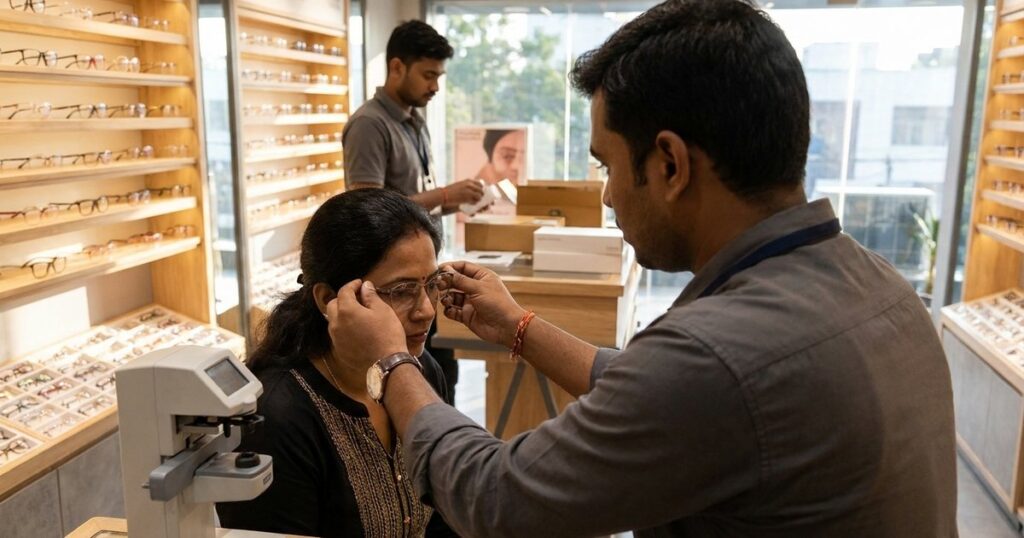
Stores do work that a product page cannot:
- Performing or facilitating eye tests.
- Allowing customers to try several frames.
- Adjusting the frame on the customer’s face.
- Explaining lens types and coatings.
- Handling complaints and exchanges.
- Converting customers who would never place a first order online.
For an Indian consumer brand, this distinction is important. The physical outlet is not automatically a drag on the model. It can be a lower-CAC acquisition channel if it produces repeat customers and referrals.
The customer record connects the channels
The useful data is not merely an email address. It includes prescription history, frame preferences, purchase frequency, store visits, returns, city, price band and product response.
This lets Lenskart answer practical questions:
- Which frame shapes sell in a particular city?
- Which price points convert after an eye test?
- Which customers are due for a replacement?
- Which stores need more inventory in a specific style?
- Which products generate returns or fitting complaints?
That data can improve buying and inventory decisions. It can also improve marketing. But do not confuse data collection with a moat. Data becomes useful only when it changes purchasing, pricing, assortment or service decisions faster than competitors can copy them.
If you are choosing a North Star Metric for your own startup, do not count app downloads or store visits. Track the behaviour that proves the operating model works. For Lenskart, that might be repeat customers purchasing within a defined period, contribution margin per customer or profitable orders after store acquisition. Our guide on choosing a North Star Metric covers this distinction.
Where Lenskart makes money
1. Prescription eyewear
Prescription spectacles are the core category. The customer buys a frame and lenses, often in a bundle. This gives Lenskart more control over the total basket than a business selling only branded frames.
The economic value comes from the combined sale:
- Frame revenue.
- Lens revenue.
- Coatings and upgrades.
- Fitting and service.
- Future replacement purchases.
A founder should study the entire order contribution, not just the gross margin on the frame. Packaging, shipping, store rent, staff, discounts, returns, remakes and payment costs can destroy an attractive-looking product margin.
2. Private-label frames
Private labels give Lenskart control over design, pricing and assortment. They also reduce dependence on external brands that own the customer relationship and can dictate commercial terms.
Brands such as Vincent Chase and John Jacobs allow Lenskart to create a price ladder. A customer can enter at a value price, trade up to a premium frame or buy a second pair for a different use case.
This is not merely a branding exercise. Private labels can improve gross margin and reduce direct price comparison. But they create inventory risk. If you design the wrong shape or overbuy a fashion trend, your capital sits in dead stock.
3. Sunglasses and contact lenses
Sunglasses add a fashion-led purchase occasion. Contact lenses can create more frequent replenishment than spectacles, although usage depends on the customer and product type.
These categories also help Lenskart monetise customers who may not need a new prescription frame immediately. The danger is category sprawl. Every adjacent category adds inventory, training, quality control and working capital. Expansion makes sense only when the existing customer base gives you a low-cost distribution advantage.
4. Store sales and franchise operations
Lenskart uses a mix of company-operated and franchise stores. A franchise model can accelerate footprint growth because the company does not fund every store’s real estate and operating cost itself.
But a franchise is not free expansion. You still need to control:
- Store location and visual standards.
- Product assortment.
- Pricing and discounting.
- Eye-test quality.
- Customer data capture.
- Returns and complaint handling.
- Training and staff incentives.
If each franchise partner behaves like an independent optician, you do not have an omnichannel chain. You have a loose collection of shops carrying your name.
5. Corporate and institutional programmes
Eye-screening programmes, school partnerships and workplace initiatives can create bulk demand and introduce the brand to large groups. They may also produce future retail customers.
Do not overrate this revenue stream. Institutional contracts often have longer sales cycles, lower prices and more operational coordination. Treat them as a distribution and acquisition channel unless the contribution margin is clearly attractive.
6. International operations
Lenskart has expanded outside India and acquired Owndays, a Japanese eyewear retailer. International growth can spread technology, sourcing and brand capabilities across markets. It also brings new regulatory, staffing, currency and retail execution problems.
Founders often describe international expansion as proof that the model travels. Investors ask a harsher question: does the business travel without importing India’s subsidies, management attention and cash?
Why vertical integration matters
Lenskart has invested in manufacturing, lens processing and supply-chain capabilities. Public reporting has described a frame manufacturing facility in Bhiwadi, Rajasthan, with reported capacity of roughly 300,000 frames per month. Treat that figure as a reported operating detail, not a guarantee of utilisation or profitability.
Vertical integration can create four benefits.
Better control over gross margin
If you buy every product from a third party, part of the value pool belongs to the supplier. Owning or tightly controlling production can improve the spread between selling price and product cost.
Faster fulfilment
Prescription eyewear is not always an impulse purchase. Customers may need it quickly. Internal lens processing and centralised fulfilment can reduce turnaround time and remake problems.
Assortment control
Lenskart can design products for specific price bands, face shapes, age groups and cities instead of accepting whatever a supplier offers.
Quality feedback
When stores, customer complaints and manufacturing sit within one operating system, product issues can travel back to design and production faster.
But vertical integration is not automatically smart. It adds fixed costs, management complexity, maintenance, quality risk and working-capital requirements. You should own a process only when it is a repeated bottleneck, a meaningful margin pool or a source of customer experience that suppliers cannot reliably provide.
Do not copy Lenskart’s factory before you copy its demand density. A plant is an advantage when volume keeps it busy. Before that, it is an expensive monument to founder impatience.
The numbers you should examine as a founder
Lenskart’s headline revenue or store count is not enough to understand the model. If you are analysing any omnichannel consumer company, build a unit economics sheet with these lines:
| Metric | What to measure | Why it matters |
|---|---|---|
| Store contribution | Gross profit minus store staff, rent, utilities, local marketing and fulfilment costs | Shows whether each outlet earns back its operating cost |
| Store payback | Total store setup cost divided by monthly store contribution | Reveals how much capital footprint expansion consumes |
| Online contribution | Net order value minus product cost, shipping, payment fees, discounts, returns and support | Prevents gross margin from hiding order-level losses |
| Repeat rate | Customers placing a second order within a defined period | Tests whether the first purchase creates a relationship |
| Blended CAC | Total sales and marketing spend divided by new customers | Shows whether growth depends on paid acquisition |
| Inventory turns | Cost of goods sold divided by average inventory | Measures how quickly cash returns from stock |
| Remake and return rate | Orders requiring replacement, correction or refund | Captures hidden quality and service costs |
For store payback, use a conservative formula:
Store payback months = total setup cost ÷ monthly store contribution after local operating expenses.
Do not use gross sales. A store doing ₹20 lakh in monthly revenue can still be a poor investment if discounts, rent, salaries, inventory and remakes consume the contribution.
Also separate company-owned stores from franchise stores. Their economics differ. A company-owned store carries more capital and operating risk. A franchise store may require less company capital but can create weaker control and different revenue recognition.
The flywheel is real, but it is not magic
Lenskart’s operating loop looks like this:
- Stores and digital marketing acquire customers.
- Eye tests and purchases create customer and prescription data.
- That data improves assortment and replenishment.
- Private labels improve product margin and price control.
- Better availability and service improve conversion.
- Customers reorder through digital channels.
- Higher volume supports more supply-chain investment and store density.
This is a useful example of a flywheel business model, but a flywheel does not turn because you draw arrows in a pitch deck. Each loop needs a measurable operating input.
For example:
- More stores should reduce customer acquisition cost or increase local demand.
- More customers should improve buying data, not just inflate a database.
- More volume should improve procurement or manufacturing utilisation.
- Better margin should fund service and retention, not only discounts.
- Repeat orders should arrive without paying full CAC again.
If every new customer still requires heavy discounts and paid advertising, your flywheel is a marketing funnel with a diagram around it.
What Lenskart did that most founders underestimate
It accepted operational pain
Many founders want a clean software story. Lenskart built stores, supply chain, manufacturing and customer service. These are harder to present in a pitch deck and harder to run than an app. They are also harder for a competitor to copy quickly.
It used offline to make online stronger
The common mistake is to treat stores and digital as competing channels. Lenskart’s better approach is to assign each channel a job. Stores handle confidence and first purchase. Digital handles convenience, discovery and repeat behaviour.
It built a price ladder
A customer does not have one permanent willingness to pay. You need a credible entry option, a mainstream option and a premium option. Private labels make that possible without depending entirely on external brands.
It made a low-frequency purchase more repeatable
People do not buy spectacles every week. Lenskart added contact lenses, sunglasses, second pairs, replacement lenses and service interactions to increase customer value between major prescription purchases.
This is a useful test for your own category: if the core product is low frequency, can you create legitimate repeat use without inventing a subscription nobody wants?
Where the model can break
Store growth can hide weak economics
Store count is a vanity metric if mature stores do not produce healthy contribution. New stores can make reported growth look impressive while consuming cash and management attention.
Ask for same-store sales, mature-store contribution, store closure rates and payback by city. Do not accept a national average that hides weak locations.
Discounting can train the customer badly
Offers such as “buy one, get one” can increase conversion, but they can also teach customers to wait for promotions. Measure full-price sales, discount depth and contribution after the offer.
Inventory can become a silent cash drain
Eyewear has fashion risk. A wrong frame assortment does not disappear because the product is small. It sits in stores, gets discounted and ties up working capital.
Track ageing buckets by SKU and city. Set markdown rules before the stock becomes embarrassing. Founders routinely postpone this because clearing inventory makes the original buying decision visible.
Franchise quality can dilute the brand
A franchise partner may optimise for this month’s sales while you care about five-year customer value. Poor eye testing, aggressive upselling or bad complaint handling can damage the central brand.
Use mystery audits, customer-level data capture, standard training and clawbacks for repeated service failures. A franchise agreement that discusses only revenue share is incomplete.
Profit quality deserves scrutiny
When a large consumer company reports profit or prepares for a public listing, investors should examine cash generation, related-party transactions, deferred costs, exceptional items, inventory accounting and the gap between reported profit and operating cash flow.
Public commentary around Lenskart’s reported numbers and its 2025 IPO has raised questions that investors should not wave away. A celebrated brand can still deserve hard accounting questions. You should inspect the filings and offer documents yourself, including material risk factors, rather than relying on television narratives or social media summaries. For listed-company and public-offer information, use primary disclosures from SEBI and the relevant offer documents.
What an early-stage founder should copy
Do not copy the store count. Do not copy the factory. Do not copy the celebrity founder story. Copy the sequence of decisions.
- Find the trust barrier. Write down why a customer hesitates. Is it quality, fitting, payment, delivery, regulation or after-sales service?
- Build the smallest offline or assisted layer that removes it. This may be a partner, technician, clinic, demo centre or field agent. Do not build a national network before proving the job.
- Connect the data. A customer who starts offline should not become invisible online. Capture consented customer, order and service information in one system.
- Prove repeat behaviour. Measure second purchase, referral or renewal before you assume lifetime value.
- Own only the bottleneck. Bring production, fulfilment or service in-house when the numbers show that outsourcing is limiting margin, quality or speed.
- Expand city by city. Prove store contribution, inventory turns and staff productivity in one cluster before spreading across India.
The most important step is the first: identify the trust barrier. Founders often spend ₹30 lakh on performance marketing to overcome a problem that requires a physical demonstration, a trained person or a credible guarantee. That is not growth. It is paying to hide a broken conversion path.
A practical one-week exercise for your startup
If you are building a consumer business, complete this exercise before your next investor meeting.
- Draw the customer journey from first awareness to second purchase.
- Mark every point where a customer needs human reassurance or physical proof.
- Calculate CAC separately for online, partner and offline acquisition.
- Calculate contribution margin after returns, discounts, support and fulfilment.
- Measure payback by channel, not only blended payback.
- List the three processes that most damage speed, quality or margin.
- Choose one process to control more tightly this quarter.
Then ask a blunt question: if you stopped paid acquisition tomorrow, would your existing customers generate enough repeat demand to keep the business alive?
If the answer is no, do not rush to open stores or build a factory. Fix the product and retention loop first. Lenskart’s physical expansion worked because it supported a broader customer relationship. A store cannot rescue a product that customers do not want twice.
Bottom line
Lenskart won by abandoning the fantasy that Indian eyewear could be solved through a website alone. It combined stores, technology, private labels, manufacturing, data and repeat purchases into one operating model.
The founder lesson is sharper than “go omnichannel”. Build the missing trust and service layer, then connect it to a repeatable digital business. If you copy only the visible assets, stores, discounts and a large catalogue, you will buy yourself rent, inventory and a very expensive growth story.
Malpani Ventures works with Indian founders who want hard questions on product, unit economics and capital allocation before those mistakes become permanent.
FAQs
What is Lenskart’s business model?
Lenskart operates an omnichannel eyewear retail model. It sells spectacles, sunglasses and contact lenses through its website, app, company-operated stores and franchise stores. It improves economics through private labels, centralised supply chain, manufacturing and customer data.
How does Lenskart make money?
Its main revenue comes from prescription eyewear sales. Additional revenue comes from sunglasses, contact lenses, accessories, premium frames, store sales, franchise operations, institutional programmes and international businesses.
Is Lenskart a D2C company?
Not in the narrow sense. It began with an online-first approach, but its current model is closer to vertically integrated omnichannel retail. Digital channels and stores work together to acquire, serve and retain customers.
Why does Lenskart need physical stores?
Stores solve problems that online shopping cannot fully remove: eye testing, frame fitting, product confidence, adjustments and service. They also acquire customers who are unwilling to make their first eyewear purchase online.
What are Lenskart’s private-label brands?
Lenskart has developed in-house brands including Vincent Chase and John Jacobs. Private labels give it more control over design, pricing, assortment and margins than selling only third-party eyewear brands.
Does Lenskart manufacture its own products?
Lenskart has invested in frame manufacturing and lens processing capabilities, alongside external sourcing. The strategic benefit is greater control over product availability, turnaround time, quality and cost.
What should founders learn from Lenskart?
Do not force customers into a pure digital journey when the category requires trust, physical proof or human service. Build the smallest offline or assisted layer that removes the barrier, connect it to your digital system and prove repeat demand before investing heavily in fixed infrastructure.
What metrics should I track in an omnichannel startup?
Track channel-level CAC, contribution margin, store payback, repeat purchase rate, inventory turns, return and remake rates, mature-store sales and operating cash flow. Revenue and store count alone can hide a weak business.