
Most founders think of unit economics as something they’ll sort out later — after PMF, after the Series A, after they’ve hired a finance person. The problem is that investors in 2026 stopped waiting. With Indian startup funding down nearly 23% in Q1 2026 and deal volume almost halving, the market has shifted from “show me growth” to “show me the math.” Founders who cannot speak fluently about their Customer Acquisition Cost, Lifetime Value, and payback period are losing deals they would have won two years ago.
This is not a finance lecture. Unit economics is simply the answer to one foundational question: does the core transaction in your business make sense? Everything else — your team, your product, your pitch — is built on whether that answer is yes. The sooner you develop an honest relationship with these numbers, the better every decision you make will be.
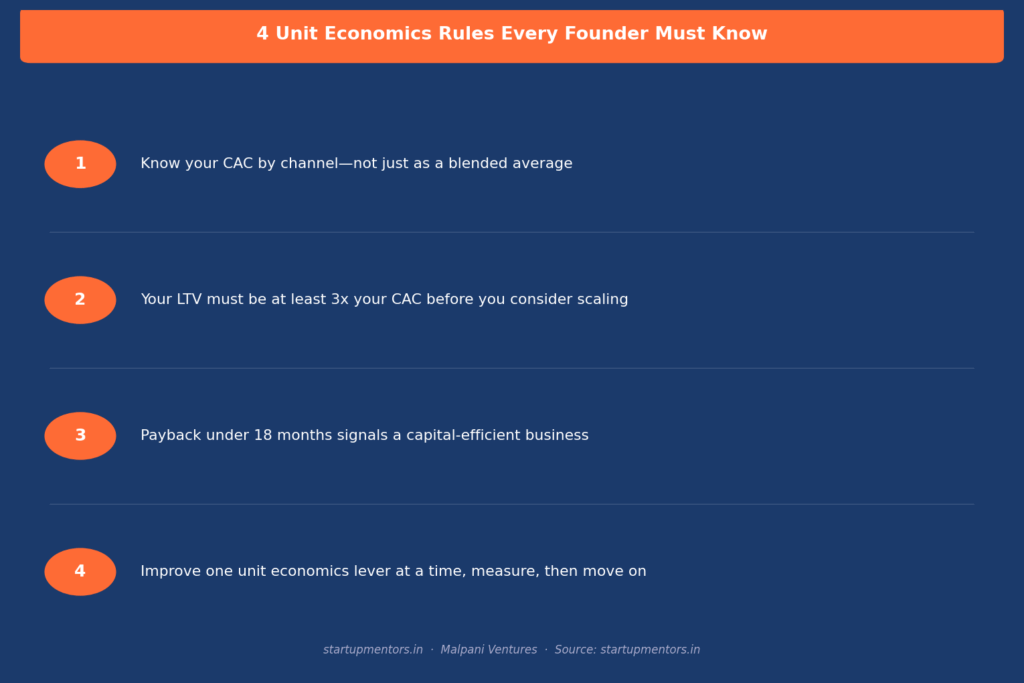
Image: Key unit economics rules for early-stage founders — Source: startupmentors.in
Why This Actually Matters Now
For a long time, you could raise seed funding in India on vision and team alone. That window has narrowed considerably. When investors in 2025 and 2026 started asking for unit economics at the seed stage, many founders were caught off guard — conditioned by a different fundraising climate where growth was the only metric that mattered.
The reason unit economics matters early is not because you are expected to have perfect numbers — you will not. It is because the direction of your numbers tells investors whether you understand your own business. A founder who says “our CAC is high right now, but we know exactly why, and here is what we are doing to bring it down” is a completely different conversation from a founder who says “margins will improve at scale.”
When Zepto was in its earliest days, it was running on a hyperlocal delivery model that had destroyed companies before it. The economics looked terrible on paper. What differentiated the founders was not that their numbers were good — they were not. It was that they could articulate with precision which variables would change and by when. That precision bought them credibility. Investors funded the trajectory, not the current state. The same principle applies to your business: you do not need perfect unit economics to raise capital. You need to understand your unit economics well enough to tell a credible story about where they are going.
The Three Numbers Every Founder Needs to Know
Customer Acquisition Cost (CAC)
CAC is the total cost of acquiring one paying customer. Add up everything you spend on marketing, sales salaries, referral fees, and any other expense directly tied to getting a customer to pay you — then divide by the number of customers you acquired in that period.
At the seed stage, your CAC is almost certainly higher than it will be once you have built brand awareness and identified your most efficient channels. That is expected. What matters is whether you know why it is high and what would need to change to bring it down. The most common mistake: many founders calculate CAC by dividing total revenue by total customers. That is average revenue per customer, not acquisition cost. Know the difference before your next investor meeting.
Lifetime Value (LTV)
LTV is the total revenue you expect to earn from a customer over the full course of their relationship with you. The basic formula: Average Monthly Revenue per Customer × Gross Margin % ÷ Monthly Churn Rate.
The gross margin piece is where founders most often trip up. You need to factor in the cost of serving the customer — cloud infrastructure, customer support, fulfilment costs — not just the revenue they generate. If your SaaS product’s hosting costs scale with usage, that directly reduces LTV. If you are in commerce, returns and logistics eat into it more than most founders initially expect.
Payback Period
Payback period tells you how many months it takes to recover what you spent to acquire a customer. If your CAC is ₹12,000 and your customer contributes ₹2,000 per month at 60% gross margin (₹1,200 net), your payback period is 10 months.
For B2B SaaS, a payback period under 18 months is generally considered healthy at the seed stage. Consumer businesses vary significantly by category. What investors are checking is straightforward: are you in a position where growing faster makes your cash problem worse, not better? If your payback period is 30 months and you raise a round every 18 months, you are perpetually dependent on external capital just to sustain your existing customer base — not to fund growth. That is a structurally fragile place to be.
Where Most Founders Go Wrong
Treating revenue growth as proof the business is working
A startup can grow 3x year-on-year and still be destroying value. If each new customer costs more to acquire and returns less over their lifetime, growth accelerates the damage rather than solving it. Meesho’s early years are instructive here. The company was growing rapidly on its social commerce model, but the underlying unit economics were deeply unfavourable. It took a significant restructuring — pulling back sharply, cutting costs, pivoting the product — to arrive at a Meesho that could eventually approach profitability. They had the capital and investor backing to make that journey. Most early-stage startups do not.
Using blended CAC instead of channel-specific CAC
Founders often report a single CAC figure — an average across all acquisition channels. This hides the most important information. Your organic CAC might be ₹400 while your paid CAC is ₹9,000. If your growth plan involves doubling paid spend, the blended number is dangerously misleading. Break CAC down by channel before making any budget allocation decision.
Ignoring churn when calculating LTV
If 20% of your customers churn every month, your expected customer lifespan is not two years — it is five months. Founders routinely use optimistic churn assumptions and arrive at LTV numbers that look defensible in a spreadsheet but collapse the moment an investor checks the underlying data. Use your actual churn rate, even when it is uncomfortable.
Treating payback period as irrelevant if you have runway
“We have 18 months of runway” is not an answer to “how long does it take you to recover your CAC?” The two are entirely different questions. Payback period determines how capital-efficient your growth can be. Understanding it does not mean you need a perfect answer — it means you need an honest one.
What to Do About It Right Now
You do not need a finance team for this. A simple spreadsheet with five inputs — monthly new customers, total acquisition spend, average monthly revenue per customer, gross margin %, and monthly churn rate — gives you everything you need to calculate CAC, LTV, and payback period. Build it today, update it monthly, and review it before any investor conversation.
Once you have the numbers, identify the single largest variable to improve. Is your CAC too high because of an underperforming paid channel? Is your payback period long because gross margin is compressed by fulfilment costs? Is LTV lower than expected because churn is running hotter than you assumed? Pick one thing and run a structured experiment over 60 days. One lever at a time produces cleaner learning than trying to fix everything simultaneously.
Most importantly, have this conversation before you need to. The worst time to understand your unit economics is during a fundraise. If your numbers are not where you want them, you need time — to improve them, or at minimum to develop a credible story about what you are doing about them. The guides on how to know when you are ready to raise and how to manage your runway well are useful starting points before you walk into those conversations.
The Bottom Line
Unit economics will not rescue a fundamentally broken idea. But a strong idea with unclear unit economics will confuse everyone involved — including you — about whether the business is actually working. The discipline is not about precision at the early stage. It is about honesty. Knowing what your CAC, LTV, and payback period are, why they are what they are, and what levers exist to change them: that is a founder skill, not a finance skill. Build it early, and it will inform almost every significant decision you make over the next three years.