Let’s start with an uncomfortable truth: most entrepreneurs don’t run experiments. They run hope disguised as action.
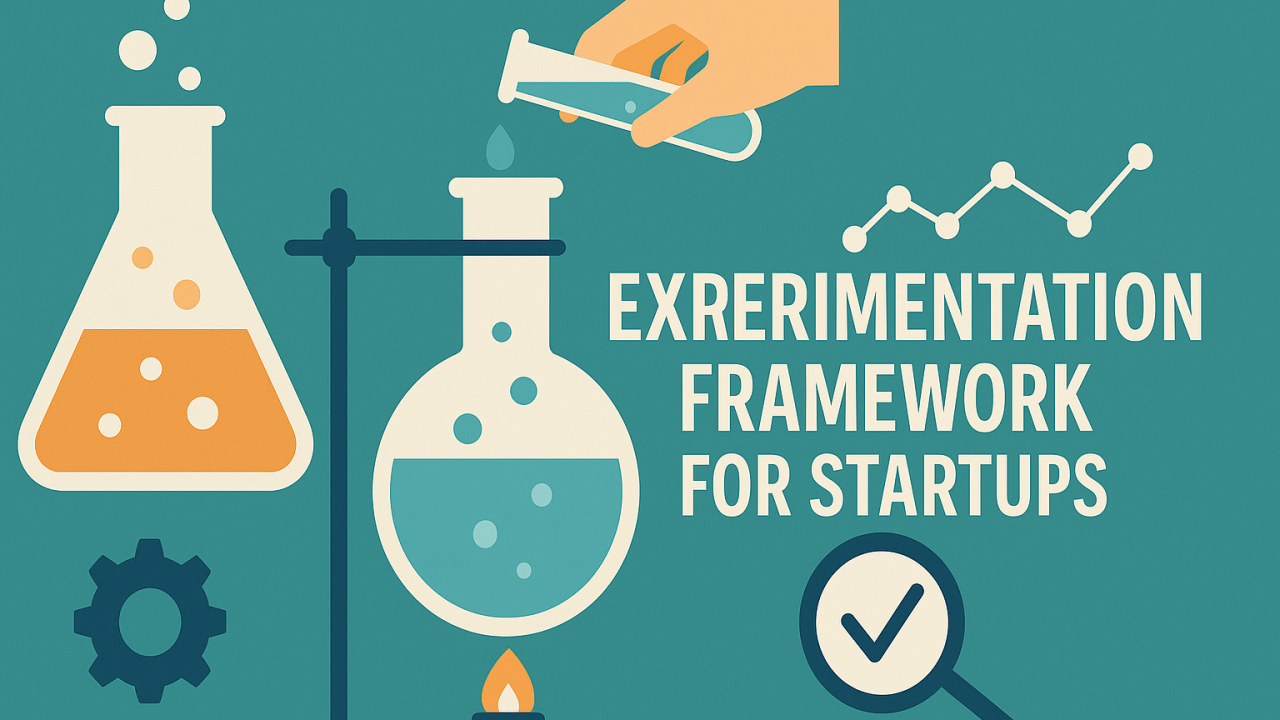
They launch features, campaigns, products — and then “see what happens.”
That’s not experimentation. That’s gambling.
If you’re bootstrapping, you don’t have the luxury to gamble. You need to learn fast, cheaply, and systematically. That’s where disciplined experimentation comes in.
Q1. What exactly is a good business experiment?
A good experiment is not about proving you’re right.
It’s about discovering where you’re wrong — quickly and cheaply.
Think of it like this:
- A bad entrepreneur says: “I think customers will love this.”
- A good entrepreneur says: “Let me design a test to find out if I’m wrong.”
The goal is not validation. The goal is clarity.
Q2. What are the key components of a well-run experiment?
Every useful experiment has six parts. Miss one, and you’re just guessing.
1. Experiment
What exactly are you testing?
Be specific.
Not: “Improve onboarding.”
But: “Will adding a 2-minute demo video increase signups?”
2. Rationale (The WHY)
Why are you running this experiment?
This is where most founders get lazy.
A good rationale:
- Identifies a clear assumption
- Connects to customer behavior
- Explains expected impact
Example:
“Users drop off because they don’t understand the product. A demo video should reduce confusion.”
If you can’t explain why something should work, don’t waste time testing it.
3. Timeline
How long will the experiment run?
Without a fixed timeline:
- You’ll stop too early if results look bad
- Or drag it forever if results are unclear
Set boundaries upfront:
- “Run for 7 days”
- “Or until we get 200 users”
Discipline beats intuition here.
4. Costs
What will this experiment cost?
Bootstrapped founders have a superpower: frugality.
So ask:
- Can I test this without building a full product?
- Can I use a landing page instead of code?
- Can I manually deliver the service first?
If your experiment is expensive, it’s probably poorly designed.
5. Expected Results
What do you think will happen?
This is critical.
Write it down before you start:
- “Conversion will increase from 10% to 18%”
- “At least 30% users will watch the video fully”
Why?
Because otherwise, you’ll reinterpret results to suit your ego.
Humans are brilliant at storytelling — especially self-deception.
6. Actual Results
What actually happened?
No spin. No excuses.
Just data.
- Conversion increased to 12% (not 18%)
- Only 10% watched the full video
This is where reality humbles you. Good.
7. Lessons Learnt
What did you learn?
This is the only thing that matters.
Not success. Not failure. Learning.
Ask:
- Was our assumption wrong?
- Did we test the right thing?
- What surprised us?
Then decide:
- Double down
- Modify
- Or kill the idea
Most founders skip this step. That’s why they stay stuck.
Q3. Why do most entrepreneurs fail at running experiments?
Because they treat experiments like:
- A formality
- Or a checkbox
Instead of a learning engine.
Common mistakes:
- No clear hypothesis
- No defined success metric
- Changing goals mid-way
- Ignoring inconvenient data
- Falling in love with ideas
Let me be blunt:
If you’re emotionally attached to the outcome, you’re not running an experiment — you’re seeking validation.
Q4. How can I design better experiments?
Use these simple principles:
Start small
Don’t build the Taj Mahal to test if people want a house.
Test behaviour, not opinions
Customers lie. Not maliciously — just optimistically.
- “Would you use this?” → Useless
- “Will you pay ₹500 today?” → Valuable
One variable at a time
If you change 5 things, you learn nothing.
Speed matters
A mediocre experiment today is better than a perfect one next month.
Q5. How do experiments help in bootstrapping?
Bootstrapping is not about saving money.
It’s about buying information cheaply.
Each experiment:
- Reduces uncertainty
- Prevents expensive mistakes
- Sharpens your understanding of customers
Think of experiments as:
“Paying ₹1,000 to avoid a ₹10 lakh mistake.”
That’s a fantastic return on investment.
Q6. How do I build a culture of experimentation?
Even if you’re a solo founder, culture starts with you.
- Write everything down
- Share learnings openly
- Celebrate insights, not just wins
- Kill bad ideas quickly (including your own)
The best founders are not the smartest.
They’re the ones who learn the fastest.
Q7. What’s the biggest mindset shift required?
Stop asking:
“Will this work?”
Start asking:
“What will this teach me?”
That shift changes everything.
Because now:
- Failure becomes data
- Confusion becomes curiosity
- And progress becomes inevitable
A simple template you can steal
Use this for every experiment:
- Experiment:
- Rationale:
- Timeline:
- Cost:
- Expected Results:
- Actual Results:
- Lessons Learnt:
If you do this consistently, you’ll outperform founders with 10x your funding.
Not because you’re smarter.
But because you’re less delusional.
Want to learn more about bootstrapping and creating sustainable businesses? Explore more insights and resources for entrepreneurs at www.malpaniventures.com . Let’s build businesses that put customers first!