
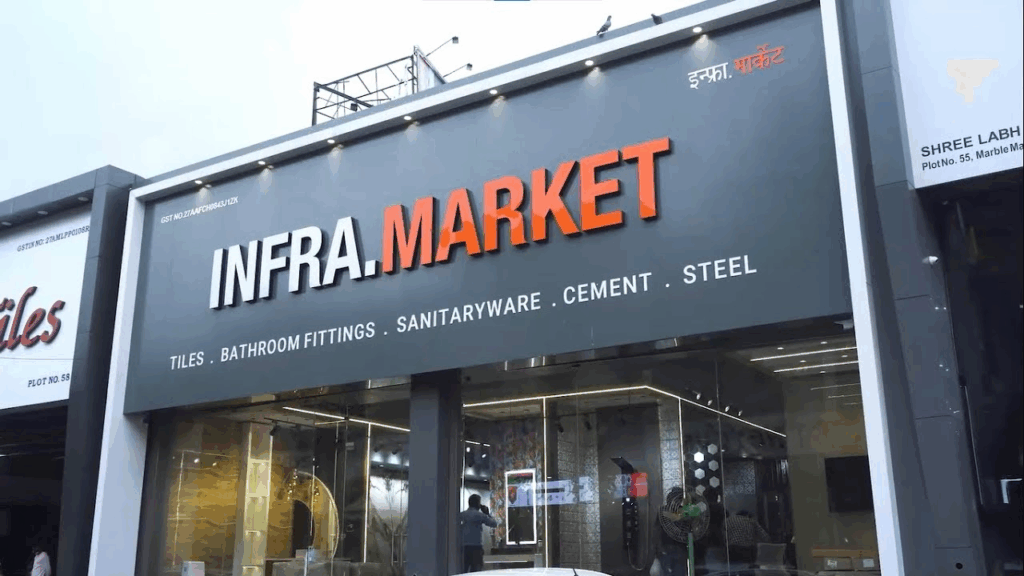
Most founders gravitate toward industries that feel modern, digital, and scalable from day one. Very few intentionally choose sectors like construction materials (cement, aggregates, steel, and chemicals) where margins are thin, operations are messy, and fragmentation is the norm. Yet, it is precisely in such industries that some of the most valuable companies are being built.
Infra.Market at a glance
- Founded: 2016 by Aaditya Sharda and Souvik Sengupta.
- What it does: a B2B platform for India’s construction-materials market, covering cement, aggregates, steel and chemicals.
- Scale: crossed ₹14,000 crore in annual revenue and reached unicorn status, in a construction-materials market estimated at over $200 billion.
- Funding and investors: raised well over $800 million across its rounds, led repeatedly by Tiger Global, with Accel, Nexus Venture Partners, Evolvence and Sistema Asia Fund also backing it.
- Valuation: became a unicorn in early 2021 and was valued at about $2.5 billion in its 2021 Tiger Global round, rising toward $3 billion in later rounds.
- The takeaway: its real product is reliability in a fragmented, brand-driven category, which is what this teardown unpacks.
Infra.Market is one such example. Founded in 2016 by Aaditya Sharda and Souvik Sengupta, the company has scaled into a multi-billion-dollar business by solving a problem most people overlooked: the inefficiency and fragmentation of construction material supply chains.
The Industry Everyone Ignored, Until Someone Organized It
India’s construction materials market is massive, estimated at over $200 billion. Despite its size, it remains highly unorganized. Contractors, developers, and infrastructure companies typically source materials from multiple vendors, each with varying levels of quality, pricing transparency, and reliability.
This creates predictable problems. Projects get delayed because materials don’t arrive on time. Costs escalate due to inconsistent pricing. Quality varies across batches. Procurement teams spend disproportionate time coordinating with vendors rather than focusing on execution.
Infra.Market recognized that the issue was not demand or supply. Both existed in abundance. The real problem was coordination, standardization, and trust. That is an almost identical pattern to what we see in manufacturing with Zetwerk.
From Marketplace to Managed Supply Chain
At first glance, Infra.Market appears to be a marketplace for construction materials. In reality, it operates much closer to a managed supply platform.
Instead of simply connecting buyers with suppliers, the company takes control of the entire value chain. It standardizes products, ensures quality, manages logistics, and often operates through private-label brands. This allows Infra.Market to deliver consistency in an industry where variability is the default.
This distinction is crucial. Marketplaces that only facilitate transactions often struggle with retention and pricing power. Infra.Market, by owning outcomes rather than just connections, builds deeper relationships with customers and becomes embedded in their operations.
The Power of Private Label in a Commodity Market
One of the most counterintuitive aspects of Infra.Market’s model is its focus on private labels in a commodity-driven industry.
Traditionally, construction materials like cement and steel are brand-driven at the top end and price-driven at the lower end. Infra.Market introduced a different approach by creating its own brands across categories such as ready-mix concrete, walling solutions, and chemicals.
This move achieves multiple objectives simultaneously. It ensures consistent quality, improves margins, and builds brand recall in an otherwise commoditized space. More importantly, it shifts the company from being a distributor to being a product owner.
In industries where differentiation is limited, controlling the product layer becomes a powerful lever.
Scale and Numbers That Signal Execution
Infra.Market’s growth reflects strong execution in a difficult category. The company has crossed ₹14,000 crore in annual revenue, placing it among the largest players in its segment. It has also achieved unicorn status with a valuation exceeding $2.5 billion, backed by investors such as Tiger Global, Accel, and Nexus Venture Partners.
The platform serves a wide range of customers, from large real estate developers to infrastructure companies and contractors. It operates across multiple categories, including concrete, steel, aggregates, and construction chemicals, effectively becoming a one-stop solution for material procurement.
What makes this scale noteworthy is that it has been achieved in a sector traditionally resistant to digitization and consolidation.
Why Investors Backed a “Low-Margin” Business
On the surface, construction materials do not appear to be an attractive venture capital opportunity. The business involves logistics-heavy operations, working capital intensity, and limited pricing power in certain categories.
However, investors saw something deeper. Infra.Market is not just selling materials; it is building a distribution and control layer over a massive, fragmented industry.
By aggregating demand and standardizing supply, the company gains:
- Better pricing power
- Higher supplier reliability
- Stronger customer stickiness
Over time, this control translates into improved margins and defensibility, even in a traditionally commoditized market.
Execution Over Innovation
A key lesson from Infra.Market’s journey is that success in such industries does not come from technological breakthroughs. It comes from execution.
The company had to solve for:
- On-time delivery across cities
- Consistent product quality
- Efficient inventory management
- Vendor reliability
Each of these problems is operational, not conceptual. Solving them requires discipline, systems, and continuous iteration.
This is fundamentally different from building a software product, where marginal costs are low and scalability is primarily digital. In Infra.Market’s case, scale is achieved through operational excellence.
Macro Tailwinds That Accelerated Growth
Infra.Market’s rise has also been supported by strong macro trends. India’s infrastructure push, increasing urbanization, and growth in real estate have significantly expanded demand for construction materials.
Government initiatives focused on roads, housing, and industrial development have further amplified this demand. As projects become larger and timelines more critical, the need for reliable, standardized supply chains becomes more pronounced.
Infra.Market positioned itself at the center of this shift, benefiting from both structural demand and its own execution capabilities.
The Real Product: Reliability at Scale
While Infra.Market operates in the construction materials space, its true product is not cement, steel, or chemicals. It is reliability.
Customers choose Infra.Market not because they cannot find suppliers, but because they want:
- Predictable delivery timelines
- Consistent quality
- Transparent pricing
- Reduced coordination effort
In essence, the company converts a fragmented procurement process into a streamlined, dependable system.
This shift, from selling products to delivering outcomes, is what drives long-term value.
What Founders Should Take Away
Infra.Market’s journey reinforces a set of principles that are often overlooked in startup ecosystems.
It shows that large opportunities often exist in industries that appear unstructured and operationally complex. It highlights the importance of moving beyond marketplaces to owning outcomes. It demonstrates that private labels can create differentiation even in commodity markets. And most importantly, it emphasizes that execution, not just innovation, is what ultimately drives scale.
Final Thought
Infra.Market did not succeed by reinventing construction materials. It succeeded by organizing how they are bought, sold, and delivered.
In doing so, it turned a fragmented, inefficient ecosystem into a structured, scalable platform.
And that is perhaps the most important lesson for founders: the next generation of large companies will not always emerge from new ideas. Many will come from bringing order, reliability, and control to industries that have operated without them for decades.
Common questions
Is it cheaper to buy building materials from a platform like Infra.Market or a local dealer?
It depends on what you are optimising for. A local dealer can occasionally beat a platform on a single spot purchase. A platform like Infra.Market aggregates demand across thousands of buyers, so it negotiates better input prices, holds more consistent stock, and prices more predictably, especially on its own private-label cement, steel and chemicals. For a contractor running a project to a deadline, the saving is less about one cheap invoice and more about avoiding the cost of a dealer who runs out of stock or ships variable quality. That reliability is the real product, which is the point this teardown makes.
What makes Infra.Market different from a traditional materials supplier?
A traditional supplier sells whatever it can source and passes on whatever price and quality the market gives that week. Infra.Market built a distribution and control layer over a fragmented category: it standardises products under its own brands, manages the supply chain end to end, and treats consistency as the thing customers actually pay for. It is less a shop and more an operating system for buying construction materials.
More Indian startup teardowns
- Styl AI: Dhruv Bindra’s data-first playbook
- Log9’s collapse: 4 deeptech mistakes every founder must avoid
- How Captain Fresh rebuilt from zero: India’s most dramatic pivot
- What Zetwerk teaches us about building enduring startups
- Key SSHA clauses every startup founder should review
See all Indian startup teardowns
We run a WhatsApp group where Indian founders swap real numbers and the hard lessons behind teardowns like this one. Join the founder community.