
The conventional wisdom about Indian startups has always been: raise fast, grow fast, exit in 7-10 years. But what happens when your product takes a decade just to get out of a lab?
That’s the reality for founders building in semiconductors, green hydrogen, quantum computing, and AI infrastructure. The normal startup clock was never designed for them. And until recently, the government’s startup framework wasn’t either.
That changed in February 2026. In a move that flew under the radar for most tech media, India’s Department for Promotion of Industry and Internal Trade (DPIIT) revised its startup recognition framework, doubling the eligibility window for deep tech companies from 10 to 20 years, and tripling the revenue ceiling from ₹100 crore to ₹300 crore. Simultaneously, a $1.85 billion-plus India Deep Tech Alliance, backed by Accel, Blume Ventures, Qualcomm Ventures, Kalaari Capital, Premji Invest, and advised by Nvidia, has been pooling patient capital specifically for founders in these sectors.
If you’re building anything that lives at the intersection of hard science and commercial application, read this carefully.
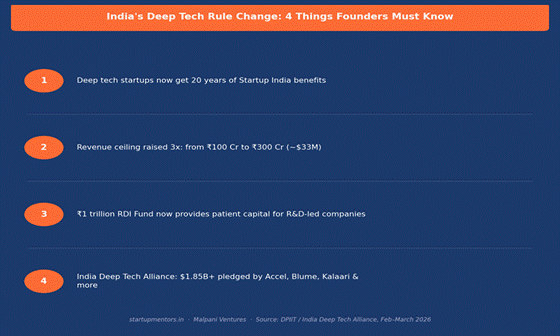
Image: India’s deep tech startup rule changes, 4 things founders must know. Source: DPIIT / India Deep Tech Alliance, Feb, March 2026
What Changed: The Three Specific Rule Updates
For the last decade, DPIIT’s Startup India programme offered significant benefits, tax exemptions, fast-track fund access, self-certification under labour and environmental laws, to recognised startups. But there was always a hard ceiling: once a company crossed ₹100 crore in annual revenue, or reached its 10th anniversary, the ‘startup’ label and all the benefits attached to it disappeared.
For a software startup, that made sense. A SaaS company that cannot reach ₹100 crore in 10 years has a product problem. But for a green hydrogen company still in its pilot phase at year eight? Or a semiconductor design startup that just shipped its first chip? The old framework was punishing founders for choosing genuinely hard problems.
The February 2026 revisions fix this in three specific ways:
1. Extended Timeline, 20 Years Instead of 10
Deep tech startups now qualify for Startup India benefits for up to 20 years from incorporation. This aligns the policy timeline with the actual development curve of hard science companies, which typically take 8-12 years to reach commercial scale.
2. Higher Revenue Ceiling, ₹300 Crore Instead of ₹100 Crore
The threshold at which a company ‘graduates’ out of startup status has been raised to ₹300 crore (approximately $33 million). This gives deep tech companies more room to grow while still accessing public procurement preferences, tax benefits, and regulatory simplifications that are genuinely valuable during the scaling phase.
3. Expanded Tax Deduction Window Under Section 80-IAC
Eligible startups can claim a 100% deduction on profits for three consecutive financial years. Deep tech companies now have the full 20-year window to pick those three years, giving them far more flexibility to time tax relief when it’s actually useful, rather than having to claim it in years when profits may be minimal anyway.
What the India Deep Tech Alliance Means for Founders
Shortly before the government changes, a group of eight Indian and U.S. venture firms formalised the India Deep Tech Alliance, pledging over $1 billion in capital to Indian deep tech startups over the next decade. Members include Accel, Blume Ventures, Celesta Capital, Gaja Capital, Ideaspring Capital, Premji Invest, Tenacity Ventures, and Venture Catalysts, with Qualcomm Ventures, Kalaari Capital, and Nvidia joining as the alliance expanded to over $1.85 billion in committed capital.
The targeted sectors are specific: semiconductors, space, quantum computing, robotics, and AI infrastructure.
What’s notable here isn’t just the money. It’s the explicit acknowledgment that deep tech needs a different kind of capital, patient, thesis-driven, and comfortable with 7-10 year development cycles. Traditional VC timelines have not served deep tech founders well. This alliance is a structural bet that India’s next wave of globally competitive companies won’t come from apps or marketplaces, but from labs and R&D floors.
For founders in these spaces, this is the most concentrated pool of aligned capital India has ever seen for hard tech. But it’s not a cheque-writing machine you simply walk up to. To access it, and to make the most of the new government framework, you need to know exactly how you qualify.
Key Learnings for Founders
1. The Government’s Revised Criteria Is Also Your Fundraising Pitch Framework
DPIIT’s new definition of a ‘deep tech startup’ requires four things: solutions based on new scientific or engineering knowledge, a high proportion of R&D expenditure relative to revenue or funding, ownership of significant novel intellectual property, and long development timelines with high capital requirements.
Read that list again, it’s not just a regulatory checklist. It’s exactly what patient capital investors want to see documented. If you can show R&D as a percentage of your total spend, demonstrate your IP ownership, and articulate why your development timeline is inherently long (not just slow), you’re already halfway to a compelling fundraising narrative. Most early-stage deep tech founders struggle to articulate this clearly because they’re too close to the science. The new policy framework is effectively a vocabulary exercise, get comfortable using it.
2. Patient Capital Is Now Findable in India
Before 2025, if you were building a deep tech company in India, your realistic options for aligned capital were limited: a handful of specialist funds, government grants, and a few global VCs who might understand what you were doing. Most generalist Indian VCs had no appetite for 8-year development cycles.
The $1.85 billion India Deep Tech Alliance changes the landscape. It signals to the broader investor community that there is a legitimate, concentrated thesis forming around Indian deep tech. This matters for founders even if you don’t end up raising from Alliance members directly, it creates anchors for the narrative you’ll use with every other investor.
3. The 20-Year Clock Starts at Incorporation, Not at Revenue
This is important to understand operationally. The 20-year deep tech window is measured from the date of company incorporation, not from your first product or first rupee of revenue. If your company is already five years old and you haven’t registered as a Startup India entity yet under the new deep tech criteria, you’ve already used five years of your window. Get registered now, so you start accumulating the benefits that will matter when you reach profitability.
4. Not All ‘Deep Tech’ Will Qualify, Be Honest About Where You Sit
The DPIIT criteria is specific. You need novel IP, meaningful R&D expenditure, and genuinely long gestation periods. A software product with AI features isn’t deep tech. Neither is a hardware product that applies existing science to a new market. The honest test: does your product require new scientific or engineering knowledge that doesn’t currently exist, or does it apply existing knowledge in a new context? The former is deep tech. The latter is a product startup, and there’s nothing wrong with that, but don’t try to fit it into this framework just to access the benefits.
What You Can Do This Week
Here are four specific actions worth taking before the end of this week:
- Apply for DPIIT recognition under the new deep tech criteria if you’re building in semiconductors, cleantech, biotech, space, quantum computing, robotics, or AI infrastructure. Registration is through startupindia.gov.in. It unlocks tax benefits, public procurement preferences, and regulatory simplifications across labour and environmental laws.
- Audit your R&D spend as a percentage of revenue or total funding raised. This is one of the key qualifying metrics for deep tech status. If you’re not tracking it explicitly, start now, it will appear in due diligence with every Alliance-affiliated fund and needs to be answered clearly.
- Research the India Deep Tech Alliance member firms, Accel, Blume Ventures, Celesta Capital, Ideaspring Capital, Premji Invest, Kalaari Capital, and find a portfolio company in each that is adjacent to what you’re building. Warm introductions through those founders are significantly more effective than cold outreach for funds of this type.
- Prepare a one-page IP and development timeline summary before your next fundraising conversation. Show: what novel IP your company owns or is developing, your R&D expenditure history, and a realistic development milestone timeline with clear go/no-go decisions at each stage. This is useful for both DPIIT recognition and investor conversations.
The Bottom Line
India has always had deep tech ambition. But the infrastructure for it, the policy framework, the aligned capital, the long-term institutional support, has lagged behind. The February 2026 changes, combined with the India Deep Tech Alliance, are the most significant structural shift in the Indian deep tech ecosystem in a decade.
The founders who will benefit most aren’t those who read about this and move on. They’re the ones who get their registrations in order, document their IP and R&D rigorously, and start building relationships with the right capital before they need it.
If you’re building something genuinely hard, India just made it a little easier to survive long enough to succeed. The window is open, use it.