
If you’re raising institutional capital — especially from a Micro-PE or growth-oriented fund — the Investment Committee (IC) is the real arena.
The partner meeting is theatre.
The IC is underwriting.
Given your orientation toward scalable, revenue-proven, unit-economics-driven businesses, this piece is written from the lens of how serious capital allocators think — not how pitch decks are designed.
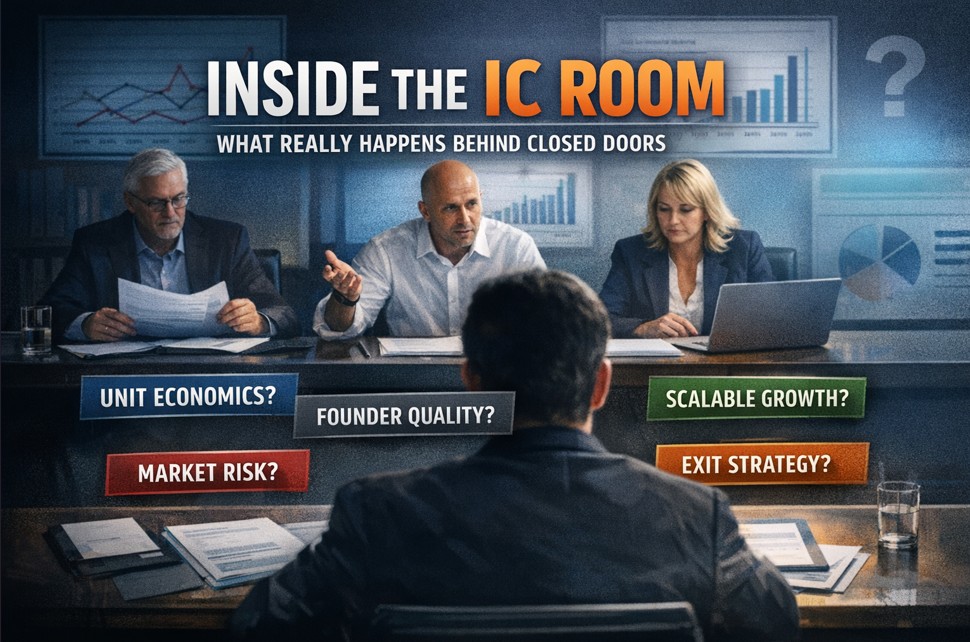
1. What Is an IC, Really?
An Investment Committee is not a brainstorming room.
It is a risk-pricing forum.
Participants typically include:
- Managing Partner
- Investment team
- Sometimes external advisors
- Occasionally sector specialists
Their job is not to be impressed.
Their job is to answer one question:
Is the risk-adjusted return profile acceptable relative to our capital mandate?
Everything else is secondary.
2. What Actually Happens Behind Closed Doors
Here’s the anatomy of a typical IC discussion.
Phase 1: Deal Champion Presentation
The internal sponsor (usually the partner who likes the deal) presents:
- Business overview
- Traction metrics
- Unit economics
- Founder assessment
- Market opportunity
- Entry valuation
- Key risks
This is where your story is re-told — without you in the room.
If your thesis is unclear, this is where it collapses.
Phase 2: Structured Dissection
Now the room shifts tone. Expect questions like:
1. Scalability vs Sellability
- Is revenue founder-driven?
- Is growth process-driven or personality-driven?
- Is customer acquisition repeatable?
If revenue depends heavily on the founder, IC flags key-man risk.
2. Unit Economics
IC doesn’t care about vanity growth. They ask:
- Contribution margin?
- CAC payback period?
- Retention curves?
- Operating leverage visibility?
If unit economics are “improving soon,” that’s not underwriting — that’s hope.
3. Market Reality
- Is TAM real or deck-constructed?
- Are customers switching from alternatives?
- Is this a budget line item or experimental spend?
4. Founder Quality
Behind closed doors, this is blunt.
Questions asked:
- Does the founder have staying power?
- Are they coachable?
- Do they understand capital efficiency?
- Have they faced adversity?
Charisma helps in meetings.
Resilience matters in IC.
5. Exit Pathways
Especially for PE-style funds:
- Who buys this?
- When?
- At what multiple?
- Is this a platform or a feature?
No clear exit logic = weak IC conviction.
3. The Hidden Filters IC Uses (That Founders Don’t See)
From experience with disciplined capital allocators, here are silent filters:
▪ Revenue Quality > Revenue Quantity
Repeat revenue with proof of retention beats flashy GMV.
▪ Founder Energy vs Endurance
Can you do this for 7–10 years?
▪ Capital Efficiency
How much follow-on funding will this require before stability?
▪ Optionality
Is there adjacency expansion potential?
4. How Founders Should Prepare for IC (Strategically)
If you’re serious about institutional capital, prepare for the IC — not just the partner call.
1. Pre-Answer Risk
List the top 5 risks in your own business.
If you don’t know them, IC will.
Then prepare:
- Data
- Mitigation plan
- Timeline to de-risk
Confidence without risk awareness kills credibility.
2. Make Unit Economics Boringly Clear
Have:
- Cohort tables
- CAC breakdown
- LTV logic
- Fixed vs variable cost structure
If numbers require storytelling, IC assumes fragility.
3. Show Scalability Mechanism
Not ambition — mechanism.
Examples:
- Channel expansion playbook
- Pricing power evidence
- Repeatable sales engine
- Hiring model
4. Understand the Fund’s Mandate
Not all capital is the same.
VCs underwrite narrative expansion.
PE-style funds underwrite cash-flow visibility.
If you pitch hyper-growth to a capital-efficiency fund, you create misalignment.
5. What Founders Often Misunderstand
❌ “If one partner likes us, we’re in.”
Wrong.
The IC can veto.
❌ “We just need momentum.”
Momentum without unit economics = delayed failure.
❌ “ICs focus only on numbers.”
No.
They focus on risk-adjusted durability.
6. What Makes IC Say Yes
In my observation of disciplined investors:
- Clear revenue proof
- Improving unit economics
- Founder with staying power
- Scalable system (not personality-driven sales)
- Realistic valuation
- Logical exit pathway
When these align, IC discussions become short.
When they don’t, meetings stretch.
7. A Brutal Truth
Behind closed doors, this sentence gets spoken often:
“I like the founder. I’m just not sure this is underwriteable yet.”
That doesn’t mean no forever.
It means “come back when risk is lower.”
Smart founders treat IC objections as a roadmap — not rejection.
8. Final Advice to Founders
Prepare like this:
- Think like a capital allocator
- Audit your own weaknesses
- Make risk visible before it’s discovered
- Understand what kind of capital you are raising
And most importantly:
Don’t optimize for raising. Optimize for building something that is hard to say no to.