In the world of early-stage investing, we often talk about “flywheels”—virtuous cycles where each part of a business drives the next, creating momentum that becomes unstoppable. But recently, a new type of flywheel has emerged, one that isn’t just about customer acquisition, but about the very nature of human competence.
We call it the Skill Absorption Flywheel.
This concept explains the mechanism behind the rapid rise of Generative AI. It details how knowledge is transferring from human heads into neural networks, and why this shift represents one of the greatest opportunities (and disruptions) for founders today.
Here are the most frequently asked questions about this phenomenon and what it means for the future of work and startups.
1. What exactly is the “Skill Absorption Flywheel”?
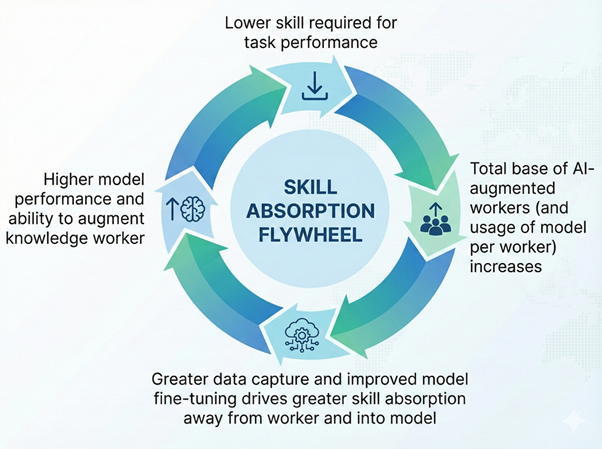
The Skill Absorption Flywheel is a model that describes how AI systems improve by observing and interacting with human workers. It is a four-step loop:
- lowering the barrier to entry for complex tasks.
- Increasing the usage of AI models by a wider workforce.
- Capturing data from those interactions to “absorb” human skills into the software.
- Improving the model to augment workers even further.
Unlike traditional software, which is a static tool, AI in this flywheel is a dynamic sponge. It doesn’t just help you do the work; it learns how you do the work, eventually incorporating that expertise into its own code.
2. How does the cycle begin?
It starts with the democratization of capability.
The top of the flywheel is defined by “Lower skill required for task performance.” Historically, high-value tasks—writing code, designing complex graphics, or analyzing legal contracts—required years of specialized training.
AI lowers this barrier. A junior developer using GitHub Copilot can now write code at the level of a mid-level engineer. A marketing intern can use Midjourney to create assets that previously required a senior illustrator. By reducing the “activation energy” required to perform a task, the market for who can do the job expands instantly.
3. Does this mean human experts are becoming less relevant?
Not necessarily, but the nature of the workforce is changing. This leads to the second stage of the flywheel: “Total base of AI-augmented workers increases.”
This is an economic principle known as the Jevons Paradox: as technology increases the efficiency with which a resource is used, the total consumption of that resource increases rather than decreases.
Because it is now easier and cheaper to produce high-quality output, more people will do it. We aren’t just seeing experts working faster; we are seeing a massive influx of “AI-augmented workers” entering fields they were previously unqualified for. For a startup founder, this means the talent pool just got significantly deeper and more affordable.
4. How does the AI actually “absorb” the skill?
This is the most critical part of the loop for investors and tech founders. The third stage is: “Greater data capture and improved model fine-tuning drives greater skill absorption away from worker and into model.”
Every time a human uses an AI model, they are generating data. When a user accepts an AI suggestion, rejects it, or edits it, they are providing Reinforcement Learning from Human Feedback (RLHF).
In the past, a worker’s skill was tacit knowledge locked in their brain. Today, as they interact with the AI, that skill is digitized. The model recognizes patterns in how humans correct its mistakes. Slowly, the “skill” moves from the biological worker to the digital model. The software is literally eating the expertise.
5. What is the end result of this data capture?
The result is the fourth stage: “Higher model performance and ability to augment knowledge workers.”
As the model absorbs more edge cases and nuances from the expanded user base, it becomes smarter. It creates a feedback loop where the AI can handle increasingly complex tasks.
For example, v1 of a legal AI might only be able to summarize a contract. But after thousands of lawyers correct its summaries, v2 can draft the contract. v3 might be able to negotiate it. This higher performance drives the cycle back to the top: the task becomes even easier, widening the funnel for even more users, generating even more data.
6. What are the strategic implications for startups?
For founders pitching to Malpani Ventures, the Skill Absorption Flywheel changes the definition of a “moat.”
- Software is no longer the moat; Data is. If you are just a “wrapper” around a generic model, you have no flywheel. The winners will be startups that build workflows where the user’s usage inherently trains the proprietary model.
- Services can become SaaS. Many business ideas that were previously unscalable service agencies can now transition into software companies. If you can use humans to train a model to do a bespoke task, you can eventually remove the human from the loop (or significantly reduce their involvement) and sell the outcome as software.
7. Is this dangerous? Are we automating ourselves out of existence?
This is a valid fear. If the skill is absorbed “away from the worker and into the model,” what is left for the worker?
The optimistic view—and the one we subscribe to—is that this raises the baseline of human potential. When the AI absorbs the “drudgery” of coding syntax, the human moves up the stack to focus on system architecture. When the AI absorbs the skill of diagnostic imaging, the doctor moves up the stack to focus on patient care and holistic treatment.
However, the “Middle Skills Valley” is at risk. Workers who rely solely on technical execution without strategic oversight must adapt. The future belongs to the “Centaur”—the human who knows how to drive the AI, not the human who tries to compete with it.
8. The Bottom Line for Founders?
When building your product, ask yourself: Is my product getting smarter with every user interaction?
If your product is static, you are building a tool. If your product is absorbing skill, you are building a flywheel. In the age of AI, only the flywheels will survive.
About Malpani Ventures: We invest in frugal, visionary founders who are reshaping industries. If you are building a company that leverages the Skill Absorption Flywheel, we want to hear from you.