This is a conversation I had with a first-time entrepreneur.
“Dr. Malpani… can I be honest?”
“You’d better be,” I smiled. “Honesty is the cheapest fuel for a startup — and ironically, the hardest to find.”
The young founder across from me took a deep breath. “I feel overwhelmed. Every day there’s a new rule, a new ‘best practice,’ a new thread on X lecturing me on how to build a unicorn. I don’t know what to follow.”
“Good,” I said. “That means your brain is still working. The moment you start blindly following startup gyaan, you’re finished. So let’s start from first principles. Tell me what you want.”
“I want to build something meaningful… and I want to succeed.”
“That’s vague,” I said. “Meaningful in what sense? And success for whom? Investors? Friends? LinkedIn? Or your customers?”
He hesitated. “I guess… for customers?”
“You ‘guess’? That’s your first mistake,” I said. “If you want to build something sustainable, scalable and profitable, there’s only one north star: Serve your users better than anyone else. Everything else is noise.”
The founder nodded slowly.
“Now,” I continued, “let me walk you through the real principles — the ones no flashy startup ‘guru’ will tell you because they don’t trend on social media.”
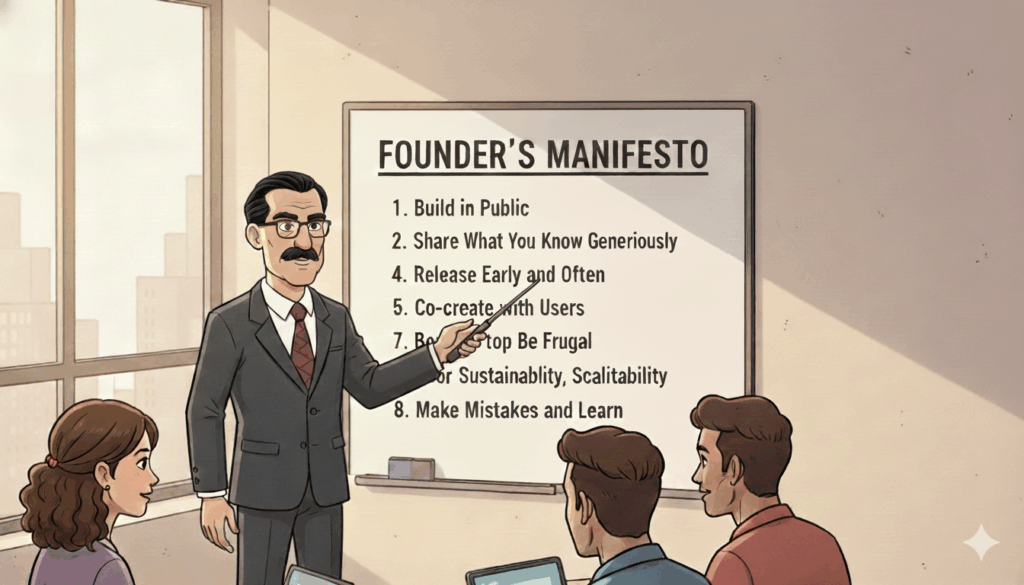
1. Build in Public — Because Transparency Builds Trust
“Why should I build in public?” he asked.
“Because,” I said, “you aren’t Steve Jobs hiding a secret iPhone prototype in a basement.”
He laughed. “Fair.”
“You’re a first-time founder trying to earn trust. When you build in public — share your thought process, your mistakes, your improvements — people feel invested. You create early believers. And those believers become early adopters.”
“But won’t competitors copy me?”
“If an idea can be destroyed by sharing, it wasn’t a strong idea to begin with. Execution is what matters — and execution improves when you’re accountable to your community.”
2. Share What You Know Generously — Because Knowledge Compounds When You Give It Away
“Everyone says ‘give value,’ but I’m not sure how.”
“Simple,” I said. “Document everything you learn. Write threads. Make videos. Share failures. Teach openly.”
“But why?”
“Because the ecosystem remembers teachers, not hoarders. And when you give freely, founders, early adopters, and even future team members gravitate to you.”
“But what if I’m not an expert yet?”
“You don’t need to be an expert. You just need to be one step ahead of someone else. Generosity is your cheapest marketing channel — and the one that compounds forever.”
3. Release Early and Often — Perfection Is The Enemy of Progress
“I’m scared to release a half-baked version,” he said.
“So your fear is more important than your users’ feedback?”
“No, of course not…”
“Then release. Ship. Put it out there. Get laughed at if needed. Better a bruised ego than a dead startup. Early releases teach you what users want — and what they don’t. You can fix a flawed product. You cannot fix silence.”
4. Co-create with Users — Don’t Build in a Vacuum
He asked, “How do I know what customers want?”
“You talk to them. Then talk again. Then talk some more.”
“But won’t users ask for contradictory features?”
“Of course they will,” I said. “That’s the fun part. Your job is to separate signal from noise. But here’s the truth most founders hate: You are not the genius inventor. You’re the facilitator. You co-create solutions with your users.”
“Isn’t that slow?”
“It’s slower at the start,” I said. “But it’s exponentially faster later because you stop building the wrong things.”
5. Bootstrap — Because Dependency Weakens Discipline
“When should I raise money?” he asked eagerly.
“When you don’t need it,” I shot back.
He blinked.
“Bootstrap first. Use your own savings. Start small. Keep your burn low. Most founders raise money to ‘look’ successful — office, staff, design agencies, PR. And before they know it, they’re managing egos, not customers.”
“So raising early is bad?”
“It’s not bad,” I said. “It’s just expensive. You hand over control. You increase pressure. And you lose the freedom to experiment.”
6. Be Frugal — Waste Is the Silent Startup Killer
“But frugal sounds… limiting,” he said.
“No,” I corrected him. “Frugal forces creativity. And creativity is the real unfair advantage.”
“What does frugality look like in practice?”
“It means:
- A laptop, not a fancy office.
- Traction, not glossy pitch decks.
- Doing sales yourself, not hiring prematurely.
- Using no-code tools.
- Avoiding vanity spends that impress nobody except your accountant.”
He laughed. “So, basically, spend like it’s your own money.”
“It is your own money. Even investors’ money is your responsibility — so treat it like blood, not confetti.”
7. Aim for Sustainability, Scalability, Profitability — In That Order
“What’s the right order?” he asked.
“First, sustainability — can your business survive?
Second, scalability — can it grow?
Third, profitability — can it thrive?”
“Isn’t profitability the goal from day one?”
“Profitability is a mindset,” I said. “You don’t need to be profitable immediately. But every decision should move you closer to profitability, not farther. Profit is proof that customers value you.”
“So I shouldn’t chase growth at any cost?”
“Never. Growth without profit is cancer — it spreads fast but eventually kills the host.”
8. Make Mistakes and Learn — But Make Small, Cheap Mistakes
He frowned. “Mistakes feel… expensive.”
“Only if you make the wrong kind. Make small mistakes. Fast mistakes. Reversible mistakes.”
“And what about big mistakes?”
“Big mistakes come from arrogance. Small mistakes come from learning. The key is to test assumptions early — before they grow into disasters.”
“So mistakes are good?”
“Only if you learn. If you keep repeating them, then it’s not called entrepreneurship — it’s called stubbornness.”
The Founder Finally Asked the Real Question
“I understand all these principles,” he said slowly. “But will doing all this make me successful?”
I leaned back.
“Success is a lagging indicator,” I said. “Follow these habits, and success becomes a by-product. Ignore them, and failure becomes inevitable.”
He nodded thoughtfully.
“What’s the biggest mistake founders make?”
“They try to look big before becoming useful. Build usefulness first — the rest follows naturally.”
“And what’s the one thing I should start doing today?”
“Simple. Talk to your users. Not once. Not twice. Do it daily. Everything great flows from understanding real people.”
The Final Advice
As the conversation ended, he asked, “So what’s the mindset I should carry with me?”
I said:
“Build with humility, share with generosity, spend with discipline, test with curiosity, and grow with integrity. That’s how you create a company worth being proud of — not just a valuation worth bragging about.”
He smiled, calmer now. “Thank you. I think I know what to do next.”
“Good. Now go build — in public. And remember: the world doesn’t need another noisy startup. It needs thoughtful builders.”
Want to learn more about frugal, ethical, customer-first entrepreneurship?
Explore more insights at www.malpaniventures.com — let’s build startups India can actually be proud of.