Picture the moment. You have raised $90 million. Your investors believe in you. You are operating in 20 to 25 Indian cities and your GMV has just crossed ₹800 crore. By every external measure, you’re a startup success story.
But Utham Gowda knew something was structurally wrong.
The domestic B2B marketplace he’d built for Captain Fresh, connecting seafood suppliers, retailers, and restaurants across India, had a unit economics problem that no amount of engineering could solve. Nearly 70% of India’s seafood consumption was compressed into roughly 200 hours a year, mostly on weekends. You can’t build a scalable, predictable supply chain business on that foundation.
Most founders in his position would have tweaked the model. Optimized. Tried a new city. Gowda did something far harder: he executed what he now calls “0 to 100 to 0”, scaling up fully, then shutting the entire domestic operation down, and rebuilding as a global export business.
On March 10, 2026, Captain Fresh announced a ₹290 crore sustainability-linked debt raise from Blue Earth Capital. The company is now IPO-bound, serves 1,300 customers across 30+ countries, and reported ₹3,421 crore in GMV in FY25, a 2.5x jump over the previous year. Here is what happened in between, and what the startup pivot India’s founders rarely talk about actually looks like when you execute it correctly.
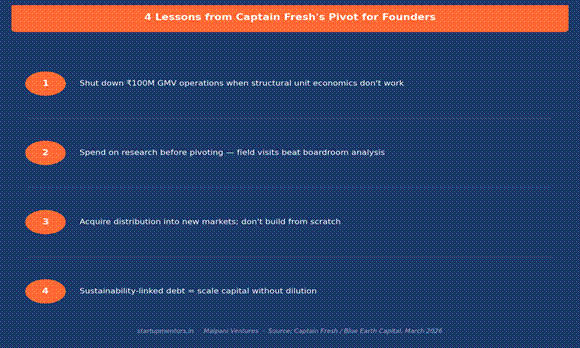
Image: Captain Fresh’s 4 key founder lessons, Source: Captain Fresh / Blue Earth Capital, March 2026
Captain Fresh at a glance
- Founded: June 2020 by Utham Gowda, a former Tata Strategic Management consultant with an investment-banking background.
- What it does: a B2B supply-chain platform for India’s fragmented seafood and fish industry, connecting suppliers, retailers and restaurants.
- Scale: reported roughly ₹3,421 crore in GMV in FY25 (a 2.5x jump), customers across 30-plus countries, and a valuation that reached $500 million.
- Funding and investors: raised around $230 million across its rounds from Tiger Global, Prosus and Accel, with a pre-IPO round in early 2025 ahead of a planned public listing.
- Recent move: on 10 March 2026 it announced a ₹290 crore sustainability-linked debt raise.
- The takeaway: its growth came through a hard pivot, not a straight line, and that pivot is what this teardown breaks down.
The Model Everyone Loved, Except the Market
Captain Fresh launched in June 2020. Utham Gowda, a former Tata Strategic Management consultant who’d spent time in investment banking, had spotted a $50+ billion sector operating almost entirely on trust, phone calls, and middlemen: India’s seafood industry. Fishermen, traders, processors, and retailers were all connected through informal networks. Technology hadn’t touched any of it.
By 2022, Captain Fresh had raised $90 million across rounds, was operating in 20 to 25 Indian cities, and hit a $500 million valuation. The pitch was compelling. The execution was solid. But the business had a structural flaw Gowda could not optimize away.
India’s seafood consumption is intensely seasonal and weekend-heavy, the “Sunday non-veg syndrome,” as Gowda describes it. With 70% of demand concentrated into roughly 200 hours per year, building a capital-efficient supply chain at scale was nearly impossible. High logistics costs, perishable inventory, and lumpy demand don’t survive contact with a marketplace model built for consistent throughput.
Rather than pivot incrementally, Gowda made a decision most founders would find terrifying: shut down domestic operations entirely. Then, between 2023 and 2025, Captain Fresh acquired 10 companies, including Koral, Senecrus, Ocean Garden, FishLog, Sekkingstad, and most recently Frime, a Spanish tuna processor. Today the company sources from 650+ suppliers across 35 countries and 90+ species, serving customers in 30+ markets. The ₹290 crore raise from Blue Earth Capital is sustainability-linked debt, meaning terms are tied to meeting environmental and impact benchmarks in its sourcing practices.
Key Learnings for Founders
1. Use Research to Make the Hard Call, Not to Avoid It
Before executing the pivot, Gowda spent $5 to 6 million on market research. Not in a conference room, he hired McKinsey and Bain for top-down market studies, but also personally visited 40 US cities over one month, two per day, examining 10 to 15 retail outlets each time. He wanted first-hand evidence of whether a global seafood distribution business could actually work.
Most founders use research to justify a decision they’ve already made emotionally. Gowda used it to answer a genuinely open question. The lesson isn’t “spend more on consultants.” It’s that when you’re contemplating a major strategic call, the quality of your evidence should match the magnitude of the decision. Are you actually visiting customers in your target market, or are you reading reports and calling it research?
2. When Something Is Structurally Broken, Don’t Optimize It, Restart It
The instinct when growth stalls is to adjust: add a feature, try a new city, hire a better sales lead. Captain Fresh’s story is a clear example of when that instinct is wrong. India’s seafood consumption pattern wasn’t a distribution problem Gowda could solve with better logistics. It was a structural mismatch between market demand and his business model.
Recognizing the difference between an execution problem and a structural one is one of the most underrated skills a founder can develop. Execution problems respond to harder work and better processes. Structural problems don’t, they require a different model entirely. The cost of staying too long in the wrong model is enormous: not just capital, but the opportunity cost of every month spent optimizing something that won’t scale.
3. Acquire Your Way Into New Markets, Don’t Build From Scratch
Captain Fresh’s international expansion didn’t involve building distribution from zero. Instead, Gowda acquired 10 companies over two years, entities that already had supplier relationships, processing capacity, regulatory approvals, and local market knowledge in their respective countries. Entering the Spanish tuna market through the Frime acquisition is a prime example: years of buyer relationships, a licensed processing facility, and an established brand, available through one transaction.
Indian founders expanding internationally tend to underestimate how long organic distribution-building takes in Western markets. Building from scratch can take 3 to 5 years. Acquiring a company that already has what you need can take 6 to 18 months, and often costs less in total. Even if a full acquisition is out of reach, the same logic applies to partnerships, distribution agreements, or minority investments in local players. When the competitive window is narrow, time-to-market is part of the equation.
4. Know the Full Toolkit of Growth Capital, Not Just Equity Rounds
Captain Fresh’s ₹290 crore raise was sustainability-linked debt, not equity. This is a form of financing where interest rates or covenants are tied to meeting specific environmental or social impact benchmarks. Blue Earth Capital, a Switzerland-based impact investor, structured the deal around Captain Fresh’s traceability and sustainable sourcing practices. The company raised substantial capital without dilution, and accessed a pool of investors (impact funds) that most equity-focused founders have never engaged with. If your company operates in seafood, agriculture, climate, healthcare, or logistics, it is worth exploring what impact-linked debt instruments might be available to you. Many founders limit their capital options to equity rounds and standard venture debt. The actual menu is wider than that, and exploring your fundraising strategy early saves you from leaving options on the table.
What You Can Do Today
Three questions worth sitting with this week:
First: Is the problem you’re trying to solve a distribution problem or a market structure problem? Before spending another month optimizing, get specific about what kind of problem you actually have. Distribution problems respond to better execution. Market structure problems require a different model. The answer changes everything about what you should do next. If you haven’t clearly identified your
If you haven’t clearly identified your north star metric and what it’s telling you about the health of the model, that’s the place to start.
Second: What would a genuine research investment look like for your current strategic question? You don’t need McKinsey. But if you’re considering entering a new market, targeting a new customer segment, or pivoting your model, are you getting first-hand evidence, or are you reading reports and calling it due diligence? Gowda visited 40 cities personally. That kind of ground truth is irreplaceable.
Third: Could any of your competitors or suppliers become acquisition targets? International expansion by acquisition isn’t only for well-capitalized companies. If you’re raising your next round and there’s a small player in a market you want to enter, a regional competitor, distributor, or supplier with the relationships you need, the conversation costs nothing. Think about what scaling without over-building actually looks like in your sector.
The Hardest Decision Is Usually the Right One
Captain Fresh’s story is not really about seafood. It’s about a founder who had the discipline to recognize when a model wasn’t working, the conviction to research the alternative rigorously, and the courage to burn down $90 million worth of domestic infrastructure and start over. The ₹290 crore raise and the IPO trajectory are not the ending, they are the evidence of what happens when you make the structurally correct call early enough to act on it.
Read more about the Captain Fresh ₹290 crore raise and the Frime acquisition story.
What’s the structural problem in your business that you haven’t been willing to look at directly? Leave a comment below, we read every one.
Common questions
Why is Captain Fresh described as a dramatic pivot?
Its growth did not come in a straight line. The company reworked how it operated in its fragmented seafood category rather than scaling the first version of the model, and that hard reset is the story this teardown breaks down.
How big is Captain Fresh now?
It reported roughly ₹3,421 crore in gross merchandise value in FY25, a 2.5x jump over the previous year, serving around 1,300 customers across more than 30 countries. It is now preparing for a public listing.
More Indian startup teardowns
- Styl AI: Dhruv Bindra’s data-first playbook
- Log9’s collapse: 4 deeptech mistakes every founder must avoid
- What Zetwerk teaches us about building enduring startups
- Why Infra.Market is quietly redefining India’s building-materials industry
- Key SSHA clauses every startup founder should review
See all Indian startup teardowns
We run a WhatsApp group where Indian founders swap real numbers and the hard lessons behind teardowns like this one. Join the founder community.