Most startup stories begin with an idea that sounds futuristic. Some start with artificial intelligence, others with fintech, SaaS, or consumer internet products. Very few begin with steel procurement, industrial chemicals, and credit for small businesses.
That is precisely what makes OfBusiness such a fascinating company to study.
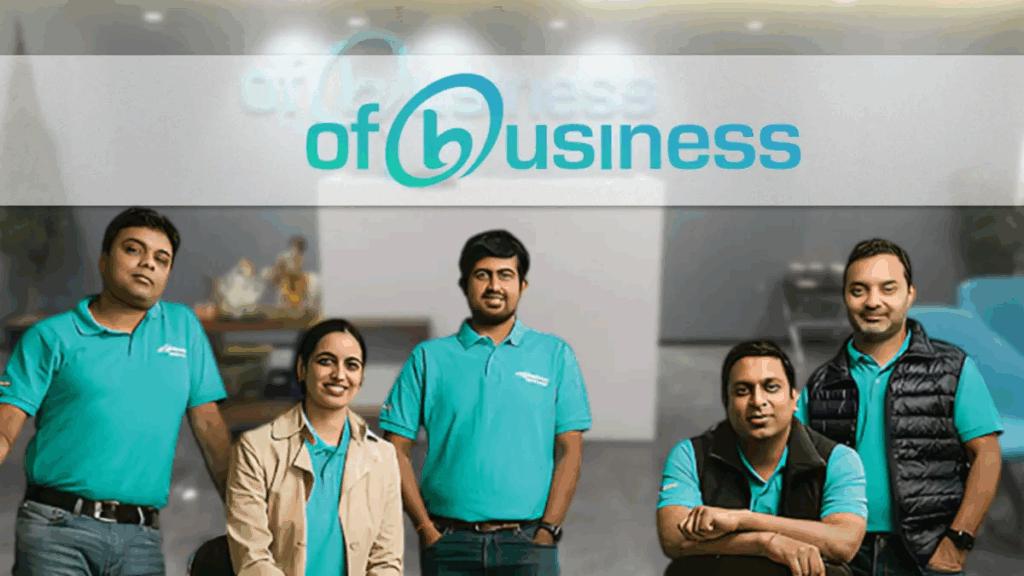
Founded in 2015 by Asish Mohapatra, Ruchi Kalra, and Bhuvan Gupta, OfBusiness did not chase glamour. Instead, it went after one of the largest and most broken parts of India’s economy: the procurement and financing ecosystem for small and medium enterprises.
What emerged from that decision was a multi-billion-dollar company that quietly became one of India’s most valuable B2B startups.
The Real Problem Was Never Just Procurement
India’s SME sector contributes significantly to the economy, yet the operating reality for these businesses is often extremely inefficient.
A mid-sized manufacturing company may need to procure raw materials such as steel, polymers, chemicals, or industrial goods. The procurement process is rarely smooth. Prices fluctuate, supply is fragmented, quality is inconsistent, and credit access is often limited.
For many businesses, the challenge is not merely sourcing materials.
The bigger issue is that procurement and financing are deeply interconnected.
A company may know where to buy, but may not have the working capital to place a large order. It may have access to credit, but not at reasonable rates. It may get competitive prices, but face delays that disrupt production cycles.
OfBusiness understood something fundamental early on: the customer problem was not transactional. It was systemic.
Instead of solving only the buying process, it decided to solve both commerce and capital.
That insight became the foundation of its business model.
A Powerful Proposition: Supply + Credit
The brilliance of OfBusiness lies in its integrated proposition.
The company helps SMEs procure raw materials and industrial goods at competitive prices while simultaneously providing financing solutions linked to those purchases.
This creates a strong value proposition.
Customers receive better procurement efficiency, access to working capital, and improved cash flow visibility, all through one platform.
In simple terms, OfBusiness does not just help companies buy goods.
It helps them run their business more efficiently.
This combination creates significantly higher stickiness than a pure marketplace.
Once a business begins relying on a platform for both sourcing and credit, switching becomes much harder.
That is where long-term value is created.
Why This Model Scaled So Fast
The company’s scale reflects how deeply it solved a real market problem.
Over the years, OfBusiness has scaled into a business generating multi-billion-dollar revenue, with its valuation crossing $5 billion, making it one of India’s largest startups in the B2B space.
Backed by investors such as SoftBank, Tiger Global, and Alpha Wave Global, the company’s growth has been driven by strong demand from manufacturing and infrastructure-linked SMEs.
What investors saw was not just a trading business.
They saw a financially embedded commerce engine.
That distinction is important.
Traditional B2B marketplaces often struggle because margins are low and customer loyalty is weak.
OfBusiness improved both by embedding financial products into the transaction layer.
The Real Moat: Data-Driven Underwriting
Perhaps the most powerful insight from the company’s journey is how it uses transaction data.
Because OfBusiness sits inside the procurement workflow, it has visibility into:
- purchase cycles
- order sizes
- vendor reliability
- payment behavior
- industry demand trends
This gives it an underwriting advantage.
Instead of evaluating SMEs using traditional credit metrics alone, it can assess real business activity in near real time.
This significantly improves lending decisions.
In many ways, this resembles how modern fintech companies use embedded data to reduce risk.
The difference is that OfBusiness applies this model to industrial and SME commerce.
This makes its lending layer stronger and harder to replicate.
A Lesson in Solving Core Business Pain
One of the biggest lessons for founders is that OfBusiness did not build for convenience.
It built for pain.
Its customers were not looking for a “better app.”
They were looking for:
- lower procurement friction
- reliable access to capital
- faster business cycles
- improved margins
These are mission-critical needs.
When your startup directly impacts revenue, cost, and cash flow for customers, retention becomes much stronger.
This is why B2B infrastructure startups can become incredibly valuable.
They solve problems that sit at the core of how businesses operate.
Why This Is More Than a Marketplace
A common mistake is to describe OfBusiness as merely a B2B marketplace.
That definition understates what it has built.
At its core, the company is a business operating system for SMEs.
It influences:
- supply chain decisions
- financing decisions
- vendor relationships
- procurement workflows
This is far deeper than transaction matching.
It becomes a workflow layer.
And once a company owns workflow, it gains both data and distribution.
Those two assets often become the basis for durable scale.
Macro Tailwinds Helped Accelerate Growth
The rise of India’s manufacturing ecosystem, infrastructure development, and formalization of SME businesses created powerful macro tailwinds.
As supply chains modernized and digital adoption improved, businesses became more willing to use integrated platforms.
Government initiatives around manufacturing and infrastructure spending further accelerated demand.
OfBusiness positioned itself perfectly at the intersection of these structural trends.
It is often the combination of strong execution and macro timing that creates category leaders.
What Founders Can Learn
The biggest takeaway from OfBusiness is that some of the largest startup opportunities exist in sectors that most founders ignore.
The business did not rely on consumer virality or software-led scalability alone.
Instead, it solved a deep operational problem with strong economic relevance.
It improved margins, reduced friction, and unlocked capital.
That is an incredibly powerful combination.
For founders, the lesson is clear: if you can sit at the center of your customer’s revenue engine or cash flow cycle, you are not just building a product.
You are becoming part of how the business functions.
That is where enduring startups are built.
Final Thought
OfBusiness succeeded because it understood that business pain is rarely isolated.
Procurement problems are often capital problems.
Capital problems are often growth problems.
By solving all three together, it built far more than a platform.
It built infrastructure for India’s business economy.
And that is exactly the kind of startup journey every founder should study.