In the startup ecosystem, success is often narrated through proxies:
valuation milestones, headline funding rounds, or the distant promise of an IPO.
But occasionally, a company shows us what actual success looks like.
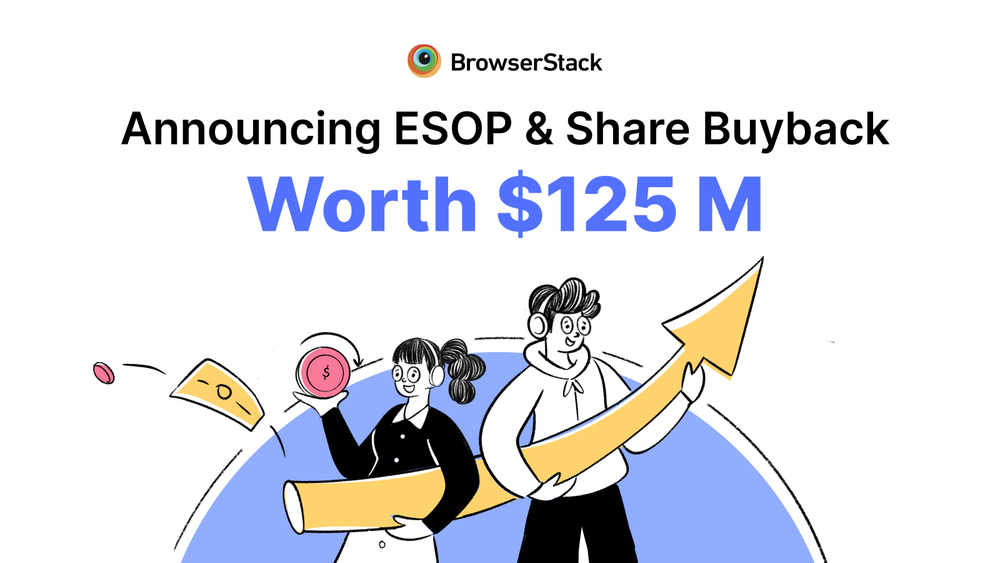
BrowserStack has returned over $275 million to employees and early investors through buybacks—while remaining a private company.
No IPO.
No forced exit.
No financial engineering.
Just cash generated by a business that works.
That is an extremely rare outcome in modern SaaS.
A Quietly Radical Move: The Buyback
BrowserStack’s recent $125M employee and investor buyback is not remarkable because of its size alone. It is remarkable because of how it was funded.
Not through a new funding round.
Not through leverage.
Not through a liquidity event.
It was funded entirely through internal accruals—profits generated from operations.
In an ecosystem where liquidity is usually dependent on external validation, BrowserStack created liquidity by simply running a profitable, compounding business.
That distinction matters.
The Foundations Were Laid Early
This outcome did not happen by accident. It is the result of a set of decisions made consistently over more than a decade.
1. Profitability Was the Starting Point, Not the Destination
BrowserStack turned profitable within six months of going commercial in 2011.
At a time when “growth at all costs” has become the default playbook, this early discipline created:
- Pricing power
- Operational rigor
- Strategic patience
Profitability was not treated as a future milestone—it was treated as proof of product-market fit.
2. Capital Was Optional, Not Existential
The company bootstrapped for nearly seven years, raising external capital only after it had already scaled to a ~$50M revenue run rate.
This had two profound effects:
- Founders retained meaningful ownership and control
- Investors entered a business with proven economics, not just potential
As a result, capital became a tool, not a dependency.
3. Scale Without Spectacle
Today, BrowserStack:
- Powers millions of tests daily
- Serves 50,000+ teams globally
- Counts Amazon, Microsoft, NVIDIA, and others as customers
- Employs over 1,000 people globally
This is real, infrastructure-level scale—achieved without burn-led theatrics or constant fundraising cycles.
From Product to Platform—Funded by Cash Flow
One of the hardest transitions in SaaS is moving from a point solution to a platform.
BrowserStack has been executing this shift deliberately:
- From browser testing to mobile, visual, accessibility, observability, and debugging
- Through a mix of in-house development and targeted acquisitions
- With AI layered on top to automate not just tests, but human effort
Critically, this platform expansion is being funded by profits, not by subsidized loss-making growth.
That significantly lowers execution risk—and increases long-term defensibility.
Why the Buyback Matters More Than the Headline
The buyback is not an act of generosity. It is a signal.
It signals:
- Confidence in future cash flows
- Alignment with employees as long-term wealth creators
- Freedom from premature exit pressure
In public markets, capital returns are expected.
In private startups, they are almost unheard of.
BrowserStack is behaving less like a “startup” and more like a capital-allocating business.
What Other Startups Can Learn From This
BrowserStack’s journey offers several lessons that are easy to admire—but hard to execute.
1. Profitability Buys Optionality
Profits don’t slow you down.
They give you leverage: over investors, over timing, and over strategy.
2. Fundraising Is Not the Business
Raising capital can accelerate outcomes—but it cannot replace sound unit economics or product value.
3. Liquidity Is a Choice, Not an Event
When a business compounds cash, liquidity doesn’t need to wait for an IPO.
4. Engineering Depth Compounds
Thirteen years of engineering-first decision-making is difficult to copy—and incredibly powerful at scale.
5. Long-Term Thinking Is a Competitive Advantage
When founders retain control and patience, strategy stops being reactive and starts becoming structural.
A Different Definition of Success
BrowserStack challenges a deeply ingrained startup myth—that success is only real when validated by public markets or acquisitions.
Here, success looks quieter, but far more durable:
- Profits instead of promises
- Buybacks instead of burn
- Control instead of compulsion
Wealth creation didn’t wait for an exit.
It happened because the business actually worked.
That is the real SaaS flex.