
You’ve built something that works. Maybe five or ten customers are using it, a few are genuinely happy, and your product holds its own against most of what the competition offers. But the next customer isn’t coming. Your emails get polite responses that go nowhere. Your demos produce good feedback and no commitment.
You start thinking you need to hire a salesperson.
You don’t. Not yet. What you need is to learn to sell yourself — and most technical founders resist this longer than they should, often until the runway is shorter than it needs to be.
Founder-led sales is the stage between “built it” and “have a team to sell it.” Done well, it gives you the most important asset in your business: a repeatable, teachable sales motion that actually works. Done poorly, or skipped entirely, you end up hiring salespeople into a vacuum — and that rarely ends well.
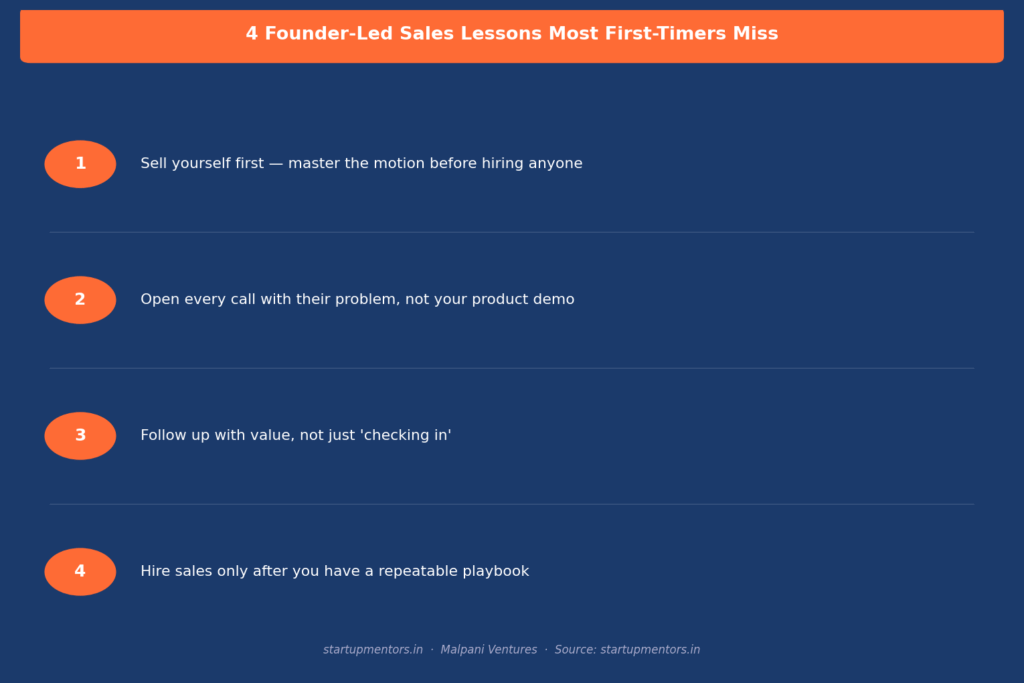
Image: 4 Founder-Led Sales Lessons Most First-Timers Miss — Source: startupmentors.in
Why This Stage Cannot Be Skipped
Most founders treat selling as a temporary inconvenience — something to endure until they can afford someone who “does sales.” This is a mistake that has cost many promising startups months and money they didn’t have.
The reason is straightforward: selling your product yourself in the early days is the most direct form of market learning available to you. Every conversation with a potential customer contains signal about your ICP, your pricing, your messaging, and your product gaps. A salesperson you hire at this stage will inadvertently shield you from those conversations. That’s not a relief — it’s a blindfold.
Girish Mathrubootham at Freshworks personally handled significant customer conversations until the company crossed $1 million in ARR. He wasn’t doing it because he lacked the budget for a salesperson. He understood that the intelligence from those conversations — the objections, the triggers, the language customers used to describe their own problems — was the foundation of the go-to-market motion Freshworks would later scale. By the time he brought salespeople in, he had a real playbook to hand them. That playbook could only have been written by someone in those conversations.
Ritesh Agarwal at OYO spent extended stretches working from OYO properties himself, talking directly to hotel owners and guests. Not just to understand operations — to understand the selling conversation: what it took to bring a hesitant property owner on board, what they were genuinely worried about, what language would land. That kind of early immersion shapes a business in ways that are hard to replicate later.
The Mindset Shift That Changes Everything
The most common mistake founders make in early sales conversations is treating them as product demos. They walk through features, explain the roadmap, answer questions about integrations. This produces polite feedback and rarely produces paying customers.
The shift: a sales conversation is about their problem, not your solution. Before you describe a single feature, you need to understand what is costing them today — in real terms. Time, money, missed opportunity, team frustration.
A structure that works consistently:
Open with genuine curiosity: “Walk me through how you’re handling [the problem] today.” Not a demo. Not slides. A conversation about their current reality.
Dig into the cost of the problem: “How long does that take? What happens when it goes wrong? What have you tried before?” You’re helping them quantify pain they’ve been living with and have likely normalised.
Anchor your solution to their specific situation: “You mentioned you’re spending eight hours a week on manual reconciliation — let me show you exactly what that looks like with us.” Not a generic demo. A targeted response to what they just told you.
Make the next step small: Don’t try to close on the first call. Close on a next step — a two-week pilot, a reference call with an existing customer, a specific conversation with their decision-maker. Every call should end with a concrete commitment to something, however small.
This approach has research behind it. A CEB/Gartner study on B2B sales performance found that the most effective salespeople — what they call “Challengers” — lead with insight about the buyer’s situation, not rapport-building. They teach buyers something about their own business before selling anything. For a founder who understands the problem they’re solving more deeply than most, this is a genuine competitive advantage. Use it.
Three Habits That Separate Founders Who Sell from Those Who Struggle
Talk to the right people first. A lot of founder selling time is lost in conversations with people who are genuinely engaged but have no budget authority or decision-making power. Before you go deep with anyone, ask clearly: “If this made sense, who would be involved in the decision?” Knowing the decision-making structure early saves weeks of pursuit that goes nowhere.
Don’t customise your way into complexity. When early customers ask for bespoke features to sign, the instinct is to say yes — every deal feels critical. The discipline: understand what’s behind the request before agreeing to anything. Usually the underlying need can be met with your existing product if positioned differently, or the request reveals something useful about your ICP. Promising custom development to close three early deals creates a product that serves no one cleanly and a sales process that can never be replicated.
Follow up like you believe in what you’re selling. Most founders follow up with “just checking in” or “no pressure if this isn’t a priority.” Both phrases signal low conviction. A strong follow-up is specific and adds value: “I saw a competitor in your space just announced X — thought this was relevant to what we discussed last week.” You’re not chasing. You’re demonstrating that you think about their business. Paul Graham’s essay “Do Things That Don’t Scale” makes this point memorably: the intensity of early founder attention to customers is itself a product differentiator. Lean into it.
When Are You Actually Ready to Hire Your First Salesperson?
The most expensive hiring mistake early-stage founders make is bringing on a salesperson before there’s a repeatable sales motion to hand them.
A salesperson needs a playbook to execute. If you haven’t closed enough customers yourself to describe the pattern — who the right buyer is, what triggers them to evaluate you, what objections come up, how long the cycle takes, what makes a deal stall — you don’t have a playbook. You have a hope that someone else will figure it out. They usually don’t.
The practical signal to look for: you’ve personally closed 10 to 15 customers following a similar pattern, and you could explain that pattern to someone new in an afternoon. That’s when a sales hire creates leverage. Before that, you’re asking someone to discover the motion while also making mistakes — it’s expensive and often demoralising for them.
When you do hire, be careful about the profile. A high-performing enterprise salesperson from a large company is often a poor fit for an early-stage startup. They’re accustomed to inbound leads, a brand that opens doors, marketing support, and an established product story. An early-stage environment offers none of that. You want someone with experience selling in a similar context: small team, limited brand, deals that require genuine hunting. For a deeper look at this decision, see our post on making your first sales hire.
The skills are genuinely different, and assuming that a track record in one environment predicts success in another is one of the more predictable and costly errors founders make in Year 1.
Start With Five Conversations This Week
The founders who eventually build strong sales organisations are almost always the ones who did it themselves first. They carry something into every future sales decision — every hire, every pitch, every board conversation about revenue — that can’t be outsourced or acquired any other way: the lived understanding of what a good sales conversation feels like, what a stalling deal looks like from the inside, and what it actually takes to turn a hesitant prospect into a committed customer.
There is no shortcut to that knowledge. Not five conversations next quarter. Five this week. And don’t call them demos — call them conversations, and let them be exactly that.
If you’re also thinking about customer discovery at this stage or how runway management shapes your selling timeline, those are worth reading alongside this.