
You opened your banking dashboard this morning. ₹2.8 crore in the account. Your monthly burn is around ₹22 lakhs. Quick division: twelve-plus months of runway. You close the tab and get back to building.
That mental math just cost you six months.
Runway is the number most founders get wrong — not because the arithmetic is hard, but because they’re measuring the wrong thing. The cash in your account isn’t your runway. Your real runway is the number of months left before you either need to be profitable or need new money in the bank — accounting for the fact that fundraising itself takes time, burn tends to go up not down, and the market’s willingness to write you a cheque shifts with conditions that have nothing to do with your business.
This post is about building the habit of knowing where you actually stand — and what to do about it.
Why Runway Is Really a Psychology Problem
There’s a reason experienced investors pay close attention to how a founder talks about their cash position. It’s not about the number itself — it’s about whether the founder has stripped away the optimism and is seeing reality clearly.
The human brain is wired to discount future discomfort. Twelve months feels like an eternity when you’re three months in. It doesn’t feel like an eternity when you’re at seven months and realising you needed to start fundraising two months ago.
Founders who get this right share one habit: they treat runway as a countdown, not a balance. Every week you’re not fundraising and not growing to profitability is a week you’ve consumed. The question isn’t “how much do I have?” It’s “what has to happen before this runs out?”
The Indian startup ecosystem had a vivid lesson in this between 2022 and 2023. Dozens of well-funded startups — companies that had raised Series A and B rounds — ran into serious trouble not because they had no money, but because they had planned for a fundraising environment that no longer existed. Inc42 documented how dozens of startups scrambled during the funding winter. The founders who survived did so because they’d already started managing burn differently, months before the market turned.
How to Calculate Your Real Runway
Before you can manage something, you have to measure it accurately.
Stop Using Gross Burn
Gross burn — your total monthly expenses — is a starting point, not a conclusion. What you actually need is your net burn: what you’re spending minus what you’re collecting.
If you’re spending ₹30 lakhs a month and collecting ₹8 lakhs in revenue, your net burn is ₹22 lakhs. With ₹2.4 crore in the bank, that’s not 8 months of runway — that’s 10.9 months. But if your revenue is growing at 10% month-on-month, your burn picture changes every 30 days, and the calculation you did in January is wrong by March.
The discipline is to recalculate every month, update your projection for where revenue will be in 3, 6, and 9 months, and see how your runway shifts under each scenario. Build a simple spreadsheet: conservative case (revenue flat), base case (current growth rate continues), optimistic case (growth accelerates). Your real runway is the conservative case, not the optimistic one.
Bake in Fundraising Time
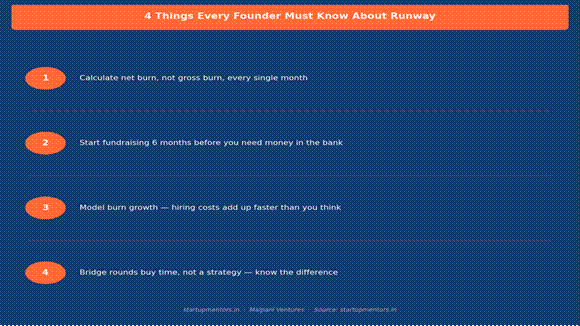
Here’s the rule most first-time founders learn the hard way: if you want money in your account by month X, you need to start your raise by month X minus 6 — at minimum.
A typical seed or Series A fundraise in India takes 3–6 months from first meeting to money in the bank. Due diligence, term sheets, legal, and actual wire transfer all take time. Startups that run into the wall do so because they started fundraising at 5 months of runway and found themselves at 2 months by the time they got to term sheet.
The working rule: if your conservative runway is 12 months, you should be in active fundraising mode by month 6. Not “thinking about it.” Active — building your list, sending decks, taking meetings. Razorpay is a useful counterexample here. They raised before they had to, consistently. By the time they needed capital, they had the luxury of choosing investors rather than accepting terms. That luxury came from planning, not luck.
Where Most Founders Go Wrong
Mistake 1: Treating burn as fixed
Burn isn’t a constant — it grows with the company. As you hire, as you expand into new markets, as you invest in infrastructure, your monthly spend goes up. Founders who model runway based on today’s burn rate and don’t account for planned hiring often find themselves 20–30% shorter than their model suggested. The discipline here is to model burn growth explicitly. If you’re planning to hire 4 people in the next quarter, calculate what your burn looks like with those salaries, not without them.
Mistake 2: Waiting for a milestone to start fundraising
“We’ll raise after we hit ₹1 crore MRR.” This sounds disciplined. It often isn’t. Milestones slip. Markets shift. And the best time to fundraise is when you don’t desperately need to — when you have 9–12 months of runway, a story that’s working, and the confidence that comes from not being under the gun. The founders who get the best terms are the ones investors can sense aren’t panicking. That calm is hard to fake when you have 4 months of cash left.
Mistake 3: The bridge round as a lifeline
A bridge round — usually from existing investors, to keep the company alive while you figure out the next raise — is a tool, not a strategy. When used well, it buys time to hit a milestone that unlocks a bigger round. When used poorly, it delays an inevitable conversation about whether the business model is working. Before you go back to your existing investors for a bridge, be brutally honest about what’s changed since the last round and why new investors haven’t come in. If the honest answer is “the business isn’t working the way we thought,” a bridge only postpones that reckoning.
What to Do Right Now
Here are four things worth doing before the end of this week.
1. Build a 12-month cash model in three scenarios.
Conservative (revenue flat), base (current trajectory), optimistic (things go well). Look at which month you hit zero in each scenario. The conservative number is your planning horizon — not the optimistic one.
2. Mark your fundraise start date on a calendar.
Take your conservative runway number, subtract 6 months, and put a fundraising kick-off reminder on that date. If that date has already passed, you’re late — start this week.
3. Audit your largest discretionary expenses.
Most early-stage startups have 2–3 cost lines that feel essential but aren’t. Cloud infrastructure, SaaS subscriptions, office space. A 15% reduction in burn often adds 2–3 months of runway — which can be the difference between a good fundraise and a desperate one.
4. Have the honest conversation with your co-founder.
The most important runway-related conversation isn’t with your investors — it’s with your co-founder. What does the business have to achieve in the next 6 months for the next raise to be realistic? Make sure you’re aligned on the answer, and make sure it’s honest, not aspirational.
The Bottom Line
Runway management isn’t glamorous. It doesn’t make for a good tweet or a great dinner story. But it’s the meta-skill that keeps all the other things you’re trying to do alive.
The founders who get to build for a long time aren’t necessarily the ones with the best ideas — they’re the ones who always know, roughly, how much time they have and what it will take to get more. Build that discipline early, and it will serve you through every stage of your company.
If you found this useful, you might also want to read our post on when and how to raise a bridge round, and our guide to writing your first investor update in a way that builds trust, not just reports numbers.
For a deeper look at the fundraising timeline math, check out Y Combinator’s advice on fundraising timing — much of it applies directly to the Indian ecosystem too.