Most founders believe that large outcomes are driven by bold ideas, breakthrough technologies, or entirely new categories. Zetwerk challenges that belief in a fundamental way. It demonstrates that a company can scale from approximately ₹21 crore in its first year to nearly ₹15,000 crore in under six years not by inventing something new, but by fixing something that already existed but didn’t work well.
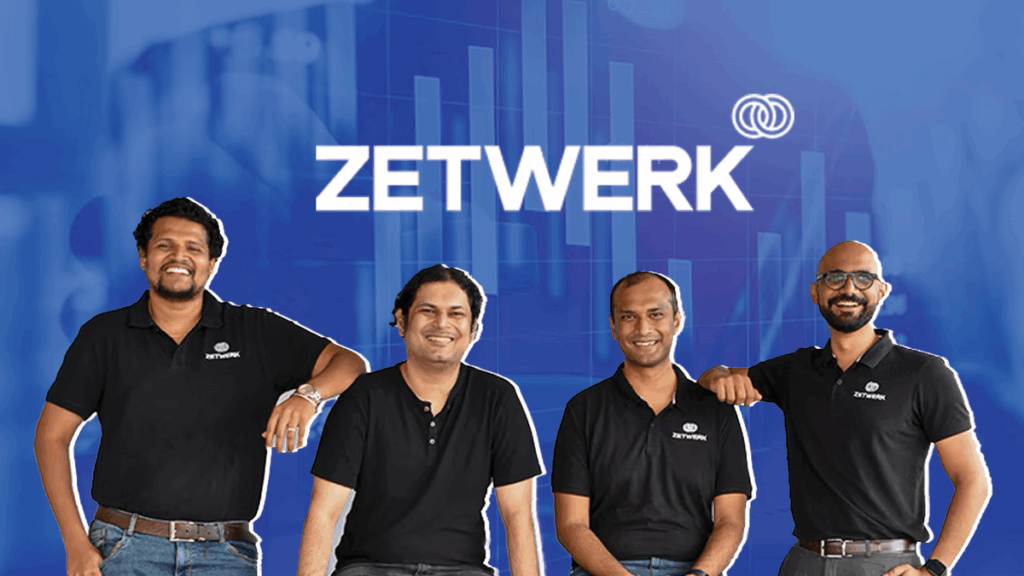
Founded in 2018 by Amrit Acharya, Srinath Ramakkrushnan, Rahul Sharma, and Vishal Chaudhary, Zetwerk did not begin with a grand ambition to transform global manufacturing. Its origin was far more grounded. Acharya’s experience managing large-scale industrial projects revealed a recurring inefficiency: even sophisticated enterprises were coordinating complex supply chains using emails, spreadsheets, and fragmented vendor networks. The issue was not the absence of manufacturing capacity but the absence of orchestration.
Acharya describes manufacturing as a domain where:
“Everything that can go wrong, goes wrong.”
The company’s earliest iteration reflected a common founder instinct. Zetwerk initially attempted to build a software layer to help companies manage suppliers. That approach failed because customers were not looking for better tools; they were looking for better outcomes. This realization led to a critical pivot. Zetwerk moved away from being a software provider and evolved into a managed marketplace that did not merely connect buyers and suppliers but took ownership of execution. That shift, from enabling transactions to guaranteeing outcomes, became the foundation of its scale.
The growth that followed was unusually rapid for a business rooted in manufacturing. Within its first year, Zetwerk generated about ₹21 crore in revenue. This scaled to ₹360 crore in the second year and ₹949 crore in the third. By FY22, revenue had reached nearly ₹5,000 crore, and by FY23 it had crossed ₹11,000 crore. More recently, the company has approached the ₹14,000–15,000 crore range, roughly translating to about $2 billion in revenue. Alongside this, its gross merchandise value crossed $2 billion, supported by a network of more than 10,000 suppliers and over 2,000 enterprise customers globally. What makes this trajectory even more notable is that the company achieved operational profitability relatively early, within roughly three years, despite operating in a capital-intensive domain.
At first glance, Zetwerk does not resemble a conventional venture-backed success. The business involves thin margins, significant working capital requirements, and high operational complexity. Yet it has raised over $800 million from prominent investors such as Lightspeed Venture Partners, Peak XV Partners, and Greenoaks Capital. Its valuation has steadily increased from around $2.7 billion in 2021 to over $3 billion in recent years, with expectations of a potential ~$4 billion valuation in an upcoming IPO. The reason investors leaned in despite the apparent challenges is that Zetwerk is not just participating in manufacturing; it is positioning itself as the control layer for manufacturing.
One of the most important insights shared by Acharya is that cost reduction was not the primary value proposition for customers. In the early days, Zetwerk attempted to position itself as a more cost-efficient alternative. That narrative failed to resonate. What customers truly valued was the ability to grow without being constrained by supply chain limitations. In sectors such as renewables and industrial equipment, companies often faced multi-year backlogs due to fragmented supplier ecosystems. Zetwerk’s ability to aggregate capacity, streamline execution, and reduce lead times effectively unlocked growth. This repositioned the company from being a cost optimizer to a growth enabler, which is a far more strategic role.
Operating in manufacturing also exposed the team to a level of complexity that most software businesses never encounter. Acharya has described the environment as one governed by “Murphy’s Law at scale,” where anything that can go wrong often does. Managing thousands of suppliers across geographies, each with their own constraints and failure points, requires not just technology but deep operational discipline. Zetwerk built internal systems to track production, monitor quality, and manage logistics, but these systems function more as control mechanisms than as standalone products. The true differentiation lies in the ability to consistently deliver outcomes in an inherently unpredictable environment.
This focus on consistency is reflected in the company’s philosophy of being “boringly predictable.” In an ecosystem that celebrates speed and disruption, Zetwerk optimized for reliability and repeatability. In manufacturing, unpredictability carries significant costs, both financial and reputational. Customers are less interested in innovation for its own sake and more concerned with whether commitments will be met without deviation. By aligning itself with this reality, Zetwerk built trust, and that trust became its most defensible advantage.
The company’s journey also highlights the importance of sequencing. Zetwerk did not attempt to build a fully integrated platform from day one. It started by addressing narrower problems such as supplier discovery and pricing before gradually expanding into execution and end-to-end ownership. Over time, it also introduced elements of vertical integration, including owned manufacturing capabilities, to gain greater control over quality and timelines. This evolution reflects a broader pattern in successful marketplaces, where initial asset-light models gradually incorporate asset-heavy components to improve reliability and margins.
Another strategic decision that played a critical role was the focus on aggregating supply early. By building a large network of manufacturing partners, Zetwerk created a foundation that could support diverse and complex customer requirements. This supply-side strength made it easier to attract demand, as enterprise clients could rely on Zetwerk as a single interface for a wide range of manufacturing needs. In fragmented markets, controlling supply often precedes and enables demand dominance.
Zetwerk’s rise was further amplified by macroeconomic tailwinds. Global supply chains have been undergoing a structural shift, with companies actively diversifying away from China and exploring alternative manufacturing hubs. India has emerged as a key beneficiary of this transition, and Zetwerk positioned itself at the center of this shift. As Acharya has noted, even a small percentage shift in global manufacturing away from China represents a massive opportunity. Zetwerk did not create this trend, but it built the infrastructure necessary to capture it.
Perhaps one of the strongest signals of founder conviction came in 2025, when the founders raised approximately ₹600 crore of personal debt and reinvested it into the company. This move is unusual and underscores a deep belief in the long-term potential of the business. In capital-intensive sectors, where external capital alone is often insufficient, such founder commitment can become a defining factor.
Ultimately, Zetwerk’s story is not about manufacturing in the traditional sense. It is about building a coordination engine for the physical world. The company’s true product is not the goods it helps produce but the reliability with which those goods are delivered. Its moat is not just technology but a combination of trust, scale, and operational control.
For founders, the broader lesson is clear. The most valuable opportunities are not always found in creating something entirely new. They are often found in deeply understanding existing systems and making them work significantly better. Zetwerk succeeded because it embraced complexity rather than avoiding it, took responsibility where others hesitated, and focused relentlessly on execution.
In a world that often glorifies innovation, Zetwerk is a reminder that organization, discipline, and trust can be just as powerful. It did not win by disrupting manufacturing. It won by making it dependable. And in doing so, it built not just a startup, but a company with the potential to become an enduring institution.