In 2018, Somdutta Singh faced a problem most Indian founders eventually run into. She had built a portfolio of successful direct-to-consumer brands in the US — supplements, wellness products — by identifying high-demand, low-competition niches using marketplace APIs. The business worked. But when she tried to take those brands to global markets beyond the US — to the Middle East, Europe, Southeast Asia — she hit a wall. The logistics were fragmented. Regulations varied by country. Technology platforms did not talk to each other. There was no single layer that could connect a brand to Amazon, Walmart, noon, and Flipkart all at once.
She looked for a solution. None existed. So she built one.
This week, Assiduus Global — the AI-powered middleware platform she founded in 2018 to solve that exact problem — raised $25 million in a pre-Series B round led by Bajaj Finserv. The company now works with more than 150 enterprise brands across 20 countries, integrated with 18-plus global marketplaces and quick-commerce platforms. Here is what every early-stage Indian startup founder should take from this.
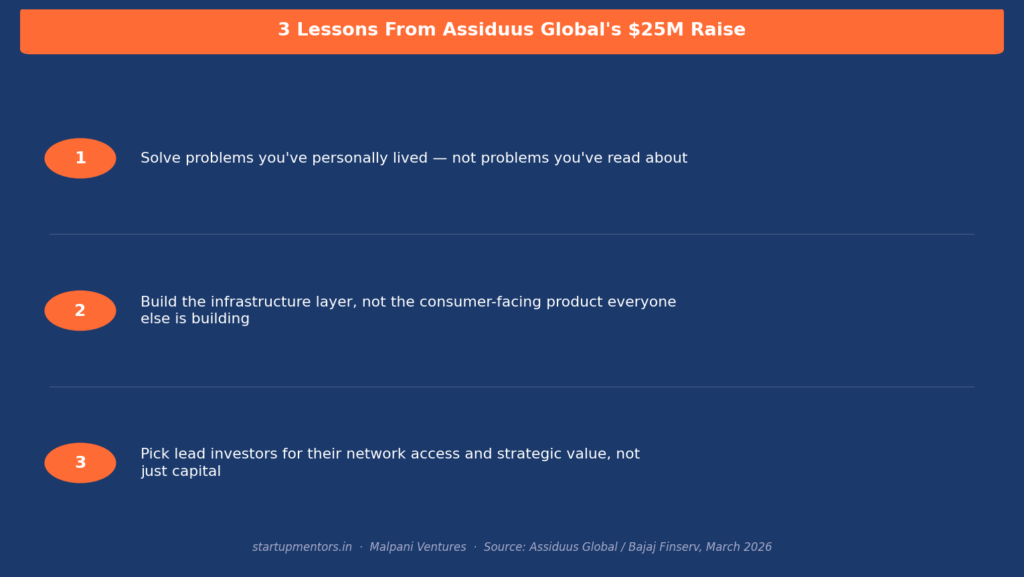
Image: Key takeaways from Assiduus Global’s $25M pre-Series B raise — Source: Assiduus Global / Bajaj Finserv, March 2026
The Cross-Border Ecommerce Wall Every Indian Founder Eventually Hits
Somdutta Singh is not a first-time entrepreneur. Before Assiduus, she founded Unspun Group in 2013, an AdTech company that was acquired within two years — making her financially comfortable before she turned 25. She used that capital to spend four years building and scaling D2C brands on global marketplaces, learning the operational mechanics of cross-border commerce from the inside.
What she discovered, painfully, was that taking a brand global is not a marketing problem. It is a plumbing problem. Every marketplace has different onboarding requirements, different fulfilment logic, different tax and compliance structures, and different customer behaviour patterns. A brand that has cracked the India market cannot simply port its playbook to the Middle East or Europe. The infrastructure does not allow it.
Assiduus Global was built to be that infrastructure — the AI-driven middleware connecting brands to global marketplaces at scale. The platform integrates with marketplaces across regions, automates compliance and logistics workflows, and uses AI to manage pricing, inventory, and demand signals across geographies simultaneously.
The latest $25 million raise, led by Bajaj Finserv with participation from Uncorrelated Ventures and Aaruha Technology Fund, will fund expansion into the Middle East, Europe, and Asia-Pacific, plus deeper AI capabilities. Full coverage is available at Business Standard and Inc42. The company had previously raised $15 million in a Series A in October 2022.
What Early-Stage Founders Should Take From This
1. Your Best Product Brief Is the Problem You Have Already Lived
The cleanest signal of product-market fit is when the person who built the product would also be its ideal customer. Somdutta Singh did not identify cross-border ecommerce infrastructure as an opportunity through a market research deck or an investor suggestion. She knew the problem was real because she had spent years inside it — building brands, trying to scale them internationally, hitting the same walls every single time.
This matters more than most founders acknowledge. Too many early-stage pitches in India describe a problem the founder has read about rather than personally struggled with. The difference shows up immediately in how precisely the problem is scoped — in which parts of the solution are non-obvious, in how confidently the founder separates real customer pain from surface-level noise.
The question worth asking, especially if you are at the idea stage: where have you personally hit a wall that no existing product adequately solved? Your answer is a more honest starting point than any trend report or industry analysis. The founder who has lived the problem spots the gaps that outsiders miss entirely.
2. In Fragmented Markets, the Infrastructure Layer Is Often More Defensible Than the Consumer Product
It is easy, when you understand a market deeply, to want to build the market-facing product — the brand, the platform, the consumer app. It is harder, and usually more defensible, to build the infrastructure that makes those market-facing products possible.
Assiduus did not build a D2C brand, though its founder had built several. It did not build a marketplace, though she understood marketplaces inside out. It built the middleware — the connective tissue between brands and the fragmented global commerce infrastructure they need to scale.
This pattern recurs across India’s most durable B2B businesses. Razorpay did not build a bank; it built the payment layer between merchants and banks. Shiprocket did not build a courier company; it built the aggregation layer that made logistics intelligible for small businesses. In complex, fragmented markets, the companies that sit between existing players and make the whole system work better tend to be stickier and harder to replace than any single platform.
If your market has multiple large platforms but no clean way for a participant to work across all of them at once, that gap is worth examining closely.
3. Your Lead Investor’s Network Is Often More Valuable Than Their Capital
The lead investor in Assiduus’s pre-Series B is Bajaj Finserv — not a traditional venture fund. This detail is easy to overlook and worth pausing on. A major Indian financial services conglomerate investing in a cross-border ecommerce middleware is not a passive financial bet. It is a signal about enterprise distribution access, regulatory relationships, and credibility in the markets Assiduus is actively targeting.
When you are deciding who leads your next round — especially as you move past seed into Series A or pre-Series B — the valuation conversation is not the only one that matters. The more important question is: what can this investor give you that you cannot build yourself in the next 18 to 24 months? A strategic partner who can open three enterprise doors worth ₹10 crore each is often more valuable than a fund that adds only capital and a brand name.
Before your next fundraise, draw up a short list of potential lead investors and rank them not by reputation alone but by strategic fit — what customers they can introduce, what markets they can unlock, what regulatory or operational credibility they carry. Let that analysis drive who you approach first.
Three Things You Can Do This Week
If you take one thing from the Assiduus story, it should be this: the most durable startup opportunities are often invisible to people who have not lived inside the problem. Here is how to apply that to where you are right now.
First, run a personal pain audit. Write down the three things in your professional or personal life that consistently frustrate you — things you have worked around, complained about, or simply accepted as unavoidable. Then ask: is there a product here? Not every frustration is a business, but founders who build from lived experience scope their problems more precisely and attract customers faster than those who start from a thesis.
Second, before you define what your product is, define where it sits in the stack. Is it consumer-facing? B2B? Or is it the infrastructure layer that makes something else possible? If you are entering a market with strong existing players — marketplaces, platforms, service providers — ask honestly whether the gap is in the consumer product or in the connective tissue between those players. The back-end layer is often less crowded, more defensible, and more attractive to enterprise buyers.
Third, when you are preparing for your next raise, build a list of ten potential lead investors sorted by strategic value, not just by reputation or fund size. For each investor on that list, note specifically what they could give you beyond capital — customers, distribution, regulatory access, sector credibility. Let that analysis determine who you go to first, not the VC brand name that sounds the best in a press release.
The Takeaway
Assiduus Global is a useful reminder that the most interesting startup opportunities are not always in the flashy consumer layer. Sometimes the real gap is in the plumbing — the infrastructure that nobody wants to build because it is complex, slow-moving, and not the kind of thing that gets written up in glossy profiles.
The founders who do build it tend to end up in positions that take years for competitors to replicate. Somdutta Singh found her idea because she lived the problem. The $25 million raise is a validation of that bet.
If you are working on something similar — going global, building infrastructure for a fragmented market, or trying to connect brands to distribution they cannot access alone — the question worth sitting with is: what is the specific wall you are trying to tear down? And have you actually tried to climb it yourself?