India just had its best year for startup funding in recent memory. Tech startups raised $9.1 billion in 2025 — a 23% jump over the previous year. DeepTech alone attracted $2.3 billion, up 37% year-on-year. M&A activity nearly doubled, with over 140 deals closing in the year. On paper, the Indian startup ecosystem has never looked healthier.
So why do 85% of seed-stage startups in India still never make it to Series A?
The NASSCOM–Zinnov India Tech Startup Report 2025 doesn’t just celebrate the headline numbers. It diagnoses a structural problem that most founders are quietly living with: the gap between building a product and building a business. The report calls it the Commercialisation Valley of Death, and it’s where most Indian startups go silent — not with a bang, but with a slow, multi-year stall that burns through runway and founder energy alike.
Here is what the data actually says, and more importantly, what you can do about it.
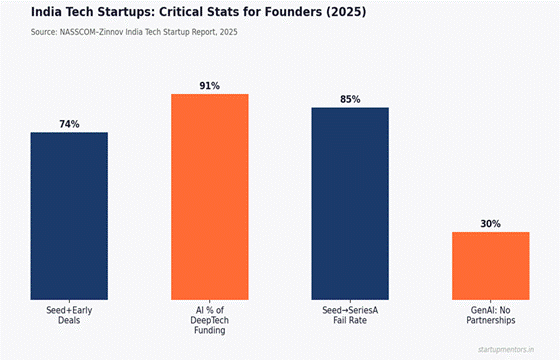
Image: Key statistics for Indian startup founders — Source: NASSCOM–Zinnov India Tech Startup Report, 2025
What the Report Found
The NASSCOM–Zinnov 2025 report analysed India’s 31,000–34,000 active tech startups across all stages and sectors, benchmarking the ecosystem against global trends. Four data points stand out for early-stage founders.
First: 74% of all deal activity in 2025 happened at the seed and early stage. Capital is flowing in at the earliest levels of the funnel, which is genuinely encouraging if you are raising your first round. But a wider early-stage funnel does not automatically mean a wider path to Series A — it means more companies competing for the same number of Series A slots.
Second: 85% of seed-stage startups in India fail to reach Series A. This number is not about ideas, engineering quality, or even market timing. The report is explicit: the Seed-to-pre-Series A transition remains the ecosystem’s most fragile stage. Many startups do not fail outright — they get stuck for years, unable to generate the commercial proof that growth-stage investors require.
Third: Startups reach technical readiness before commercial readiness. India’s engineering culture is a genuine strength, but the report identifies it as a persistent blindspot. Securing early customers has become a greater challenge than attracting talent or shipping product. Founders are building for features when they should be closing for contracts.
Fourth: AI now accounts for 91% of DeepTech funding and 84% of DeepTech startups. India’s GenAI startup formation surged 3.7X in 2025, and a disproportionate share of the 140-plus M&A deals involved AI companies. If you are building in AI, the capital environment is as strong as it has ever been. If you are not, the available pool of investor attention is getting narrower.
What This Means for Early-Stage Founders
The Funding Environment is Healthy. Your Transition Environment is Not.
It is easy to look at the $9.1 billion headline and conclude that India is a great place to raise capital right now. At the seed stage, that is actually true — 74% of all deals are happening at seed and early stages, and there is genuine enthusiasm for AI-first companies. The hard problem is what comes next.
The report describes a pattern that will sound familiar to many founders: you raise a seed round, build a strong product, run a few pilots, and generate real user interest. Then 18 months later, a Series A investor asks for MRR, signed enterprise contracts, and net revenue retention numbers — and the answers are not there yet. Not because the product failed, but because the commercial motion never got built.
That is not a technology problem. It is a commercialisation problem. And according to the NASSCOM report, it is a problem India’s ecosystem has consistently underestimated.
The Valley is Not About Running Out of Money. It is About Running Out of Evidence.
Series A investors do not fund potential — they fund proof. The evidence they want is customer revenue, contract value, and retention data. The NASSCOM report is explicit that Indian startups are spending too long on the wrong side of this equation: refining features instead of closing a first design partner, polishing the product instead of returning to the customer who said no and asking why.
When 85% of seed-stage startups never reach Series A, most of them are not technically dead. They have a product, a handful of early users, and a pitch deck with a growth curve that has not materialised yet. What they lack is a replicable, teachable sales process — something that a new hire could follow without the founder being in the room.
GenAI is a Two-Edged Trend.
India’s GenAI startup formation surged 3.7X in 2025, and enterprise demand for AI solutions is genuinely strong. Indian founders have a real structural advantage in building applied AI for global markets — deep engineering talent, lower cost structures, and proximity to massive domestic datasets.
But the report flags a specific bottleneck that is quietly killing early momentum: 30% of GenAI startups currently have no active enterprise or research partnerships. In a sector where distribution is everything and pilots are the primary proof mechanism, building in isolation is a slow death. The founders who will raise Series A rounds in 2026 are not necessarily the ones who built the best model. They are the ones who embedded their product inside five enterprises a year ago and now have case studies, renewal data, and reference customers to show.
How to Apply This to Your Startup Right Now
Treat your first customer as a Series A prerequisite, not a product validation exercise. Most founders approach early customers as beta testers. Series A investors treat them as proof of commercial viability. Before you optimise another feature, ask yourself: can this pilot become a paid contract? Even a small one. Revenue signals that a customer’s procurement process believes in you. A pilot, however enthusiastic, does not.
Map your Series A requirements backward from today. A typical India Series A requires ₹40–150 lakh in monthly recurring revenue (or clear enterprise letters of intent), three to five referenceable customers, and evidence that your customer acquisition economics work. Calculate exactly how far you are from those thresholds right now. Then build your next 12 months specifically around closing that gap, not around adding features.
Build your partner funnel the same way you build your customer funnel. The report flags partnerships as a critical weakness across the ecosystem — 30% of GenAI founders have none. Partnerships with system integrators, enterprise platforms, or complementary startups are often the fastest route to distribution at scale. Make two meaningful partnership conversations a permanent fixture in every quarter, not something you get to after the product is done.
Stop optimising for product completeness. Start measuring commercial velocity. How many customer conversations did you have last week? How many proposals went out? How many enterprise introductions did you make? These numbers matter more right now than DAU counts or feature completion rates.
Choosing the right metric to track is one of the highest-leverage decisions a founder can make — and if you’re stuck between seed and Series A, that metric needs to be a commercial one. Read our post on choosing your North Star metric to think through which number best reflects real business progress at your current stage.
The Bottom Line
India’s startup ecosystem is larger, better-funded, and more globally competitive than it has ever been. But a $9.1 billion funding market does not help the 85% of seed-stage founders who never see a Series A. The money is there. The problem is the bridge between early traction and the commercial proof that unlocks growth capital.
The NASSCOM–Zinnov report delivers an uncomfortable verdict: India does not have an innovation problem. It has a commercialisation problem. Founders who understand that distinction — and who build their sales muscle as deliberately as they build their product — are the ones who will be raising Series A rounds in 2026.
What is your biggest obstacle right now: shipping the next feature, or closing the next customer?