Every founder wants to be the startup that hits $100M ARR in 18 months. It’s a compelling story — one that fills headlines and opens fundraising doors. But Bessemer Venture Partners’ State of AI 2025 report, based on a detailed study of 20 high-growth AI startups, surfaces a counterintuitive finding: the rocketship path is actually the riskier bet for most founders.
After deploying over $1 billion into AI-native startups since 2023, Bessemer identified two archetypes winning the AI era: “Supernovas” that scale at violent speed, and “Shooting Stars” that compound steadily to the same destination. The slower path frequently produces stronger companies. Here’s what the data actually says — and what it means for your AI startup growth strategy in 2025.
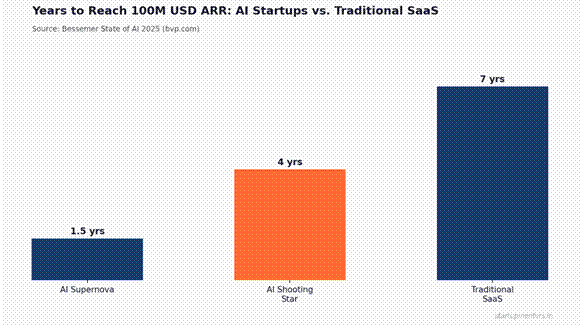
Image: Time to $100M ARR across startup archetypes — Source: Bessemer State of AI 2025 (bvp.com)
AI Startup Growth Benchmarks 2025: What the Report Found
Two Archetypes, One Destination
Bessemer studied breakout AI companies including Cursor, Perplexity, and Abridge. “Supernovas” hit approximately $40M ARR in Year 1 and $125M by Year 2, generating more than $1M ARR per employee — but at low gross margins of around 25%. “Shooting Stars” start smaller (~$3M ARR in Year 1) and compound on the “Q2T3” model — quadruple, quadruple, triple, triple, triple — reaching roughly $100M ARR by Year 4 with margins closer to 60%.
The traditional SaaS comparison is stark: historically, the best cloud companies took around seven years to reach $100M ARR. AI Shooting Stars are doing it in four; Supernovas in under two. Both paths are faster than anything that came before. The divergence lies not in destination, but in durability.
The report also tracks ARR multiples: in 2025 the average Cloud 100 multiple stood at 20x, a 41% compression from the 2023 peak. For Indian founders raising rounds, investor appetite is strong but valuations have normalised. See the full data in the Bessemer Cloud 100 Benchmarks Report.
What This Means for Early-Stage Founders
1. Most Founders Will Be Shooting Stars — and That’s Fine
The honest reality: very few startups have the combination of breakthrough technology, viral distribution, and well-timed investor backing to execute a Supernova path. Cursor had a unique product wedge in developer tooling that almost no other startup could replicate at the same moment. Perplexity had a genuinely category-defining interface. For most founders — particularly in India, where capital efficiency is a real constraint and early-stage investors are more measured — the Shooting Star model is not only more achievable but structurally healthier.
The Q2T3 benchmark gives you a concrete growth model: 4x in Year 1, 4x in Year 2, then 3x for three consecutive years. At ₹1 crore ARR today, you are targeting ₹4 crore next year and ₹16 crore the year after. Running these numbers forces honesty about your unit economics early — because compounding at this rate on thin margins will eventually break something.
2. Memory and Context Are the New Moat
One of the sharpest observations in the Bessemer report: as AI-native workflows mature, memory is becoming a core product primitive. The ability for your product to remember context, adapt to individual users, and personalise over time is what separates tools that feel useful from tools that feel indispensable.
For early-stage founders, this is a direct build instruction. If every session starts from scratch, you are commoditising yourself — as replaceable as the underlying model. Build memory early. The AI products that survive are the ones that know the user better every time they return.
3. Don’t Bolt AI onto Your Product — Rebuild the Workflow
Bessemer draws a clear distinction between “Systems of Record” — software that stores and tracks — and “Systems of Action” — software that executes. The first wave of enterprise AI was mostly bolted onto existing products as copilots and assistants. The companies winning now are those that reimagined the entire workflow from the ground up.
For Indian B2B founders especially, this matters. Legacy SaaS across CRM, ERP, HR, and finance is deeply vulnerable right now. Bessemer explicitly names Salesforce, SAP, Oracle, and ServiceNow as companies whose moats are being eroded by AI-native alternatives. The equivalent opportunity exists at the mid-market and SME layer in India — sectors where software adoption has historically been low precisely because traditional tools were too expensive and complex to implement. A founder who rebuilds one of these workflows from scratch, with AI as the primary execution layer, is building on the right side of a major transition.
4. Fundraising Benchmarks Have Shifted — Know Where You Stand
If top AI companies are reaching $100M ARR in four years instead of seven, the benchmarks investors use to assess Series A and Series B readiness have changed. Going into a raise without knowing this is an avoidable mistake. Our guide to fundraising for early-stage founders covers the process in detail — but the key point here is that the metrics conversation has shifted.
If you are growing at a “traditional SaaS pace,” investors are comparing you — fairly or unfairly — against AI-native peers growing twice as fast. The answer is not to manufacture growth or change your story. It is to understand the new benchmarks well enough to contextualise your traction accurately. Know which archetype you are building — Supernova or Shooting Star — and articulate why. Investors who understand this framework will respect the clarity far more than a founder who simply presents numbers without narrative.
How to Apply This to Your Startup Right Now
Sketch Your Q2T3 Path from Today
Whether you are pre-revenue or at ₹50 lakh ARR, map out what the Q2T3 model looks like from your current number all the way to ₹800 crore ARR (roughly $100M). What does 4x mean in terms of new customers and expansion revenue? What team size and sales motion does it require? This exercise often reveals whether your current go-to-market can actually scale — or whether you need to rebuild it now, before the stakes are higher.
Audit Your Product for Memory
Go through your product flow and ask: what does it remember about the user after their first session? Their tenth? If the answer is “almost nothing,” you have a moat problem in the making. Start simple — store a user’s common queries, their team context, their preferences, their past decisions. Build from there. The goal is to make returning to your product feel meaningfully different from starting fresh with a generic AI tool.
Target a Workflow, Not a Feature
Use Bessemer’s Systems of Action lens to find your product wedge. Instead of asking “what AI feature can I add to this sector?” ask “what is the most friction-heavy workflow in this space, and what would it look like if AI did not just assist it but owned the execution?” That is where defensible products are being built today — and where the next generation of Indian B2B breakouts will come from.
Benchmark Before Your Next Raise
Before your next investor conversation, review the Bessemer Cloud 100 Benchmarks Report and understand what ARR multiples, net revenue retention, and growth rates look like at your stage in 2025 — not from 2021 data. Going into a pitch without this context means you cannot respond effectively when investors benchmark your numbers against market comps.
Conclusion
The AI opportunity for founders is real — but it is not uniform, and it does not favour the same path for everyone. Bessemer’s data makes clear that you do not need to bet on blitzscale to win. Whether you are building for explosive growth or durable compounding, what matters is knowing which archetype you are on and making decisions that are consistent with that path.
AI startups are being measured on a faster clock now. The question is not whether to move quickly — it is whether the engine you are building can sustain the pace. Start with a clear wedge, build memory in from day one, map your path to $100M before your next raise, and know your numbers before you walk into any investor conversation. The founders who get this right in the next 24 months will be the ones setting the benchmarks for the cohort that follows.