
India just gave deeptech founders more time. In February 2026, the government extended the “startup” window for deep tech companies to 20 years — double the previous limit — and raised the revenue threshold for tax and regulatory benefits to ₹3 billion. The message was clear: we know deeptech takes longer, and we want to support it.
Log9 Materials would have loved this policy. The Bangalore-based EV battery startup spent years building what looked like India’s answer to Tesla’s battery ambitions — raising significant capital, signing enterprise fleet deals, and making headlines as a deeptech startup failure India would be watching closely. Then, in May 2025, it collapsed under ₹200 crore in debt, creditor lawsuits, and mass layoffs.
The government can extend timelines. It cannot fix the mistakes that caused Log9’s collapse — and those mistakes are ones every early-stage deeptech founder is at risk of repeating right now.
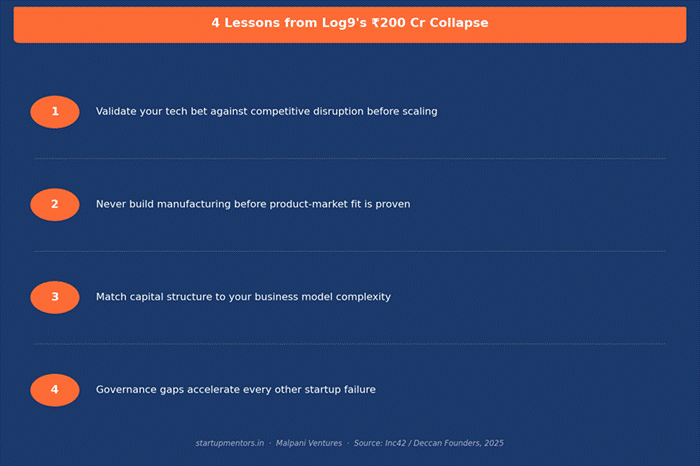
Image: Key takeaways from Log9 Materials’ collapse — Source: Inc42 / Deccan Founders, 2025
From Deeptech Darling to ₹200 Crore Insolvency
Log9 Materials was founded in 2015 by Akshay Singhal and Kartik Hajela, both IIT Roorkee graduates who wanted to commercialise aluminium-air battery technology. Over the next several years, the company went through multiple pivots — from aluminium-air fuel cells to lithium-titanate oxide (LTO) batteries — before settling on fast-charging EV battery packs for three-wheelers and buses.
By 2022–23, Log9 was a media darling: backed by venture capital, signing fleet deals with Amara Raja and other enterprise customers, and expanding its manufacturing footprint. The company invested ₹150 crore in a battery cell manufacturing plant. It had the narrative, the backing, and the press coverage that deeptech founders dream of.
Then the cracks showed. Customers reported that the vehicles couldn’t deliver promised range or speed. The LTO technology Log9 had staked its future on was being outcompeted by cheaper, more energy-dense LFP (lithium iron phosphate) batteries flooding in from China. By 2024, Log9’s core product had lost its competitive advantage. Debt crossed ₹200 crore. Layoffs followed. The NCLT admitted the company into insolvency proceedings in 2025.
Key Learnings for Deeptech Startup Founders
1. A Technology Bet Is Also a Market Bet — and Markets Move Fast
Log9 chose LTO batteries because they could charge fast and handle high temperatures — both legitimate advantages for Indian conditions. What the team underestimated was how quickly the competitive landscape would shift. Between 2022 and 2024, Chinese LFP cells dropped dramatically in cost while improving in performance. The same technology risk that looked manageable in 2020 became terminal by 2024.
For deeptech founders, this is a sobering reminder: your technology bet is inseparable from your market timing bet. Before committing capital to a specific technical architecture, build explicit assumptions about how competing technologies will evolve. What happens to your unit economics if a well-funded competitor’s solution drops 40% in cost within two years? Run that scenario before you spend ₹150 crore on manufacturing infrastructure. The best deeptech bets account for competitive disruption, not just technical feasibility.
2. Never Scale Manufacturing Before You’ve Nailed the Product
Log9 invested heavily in a cell manufacturing plant that never reached intended scale — and the company ended up importing Chinese cells anyway, defeating the purpose of vertical integration. This is a painful illustration of a classic startup mistake: scaling infrastructure before proving the product.
The correct order of operations is clear in retrospect. First: prove the product works reliably for customers at small scale. Second: understand your unit economics deeply. Third: decide whether to manufacture or source. Log9 appears to have reversed steps one and three, building manufacturing capacity before the product consistently delivered on its performance promises. Customers found the vehicles underpowered and expensive to operate. The manufacturing plant that was supposed to create competitive advantage instead created fixed costs that a struggling company couldn’t sustain.
3. Venture Capital Has a Different Risk Profile Than Asset-Heavy Businesses
Venture capital is designed for businesses with high gross margins, fast iteration cycles, and the ability to scale without proportional capital. Manufacturing businesses — especially capital-intensive ones requiring plants and supply chains — have fundamentally different economics. Log9 raised VC money and then tried to build a manufacturing business. This created a structural mismatch.
VC investors expect growth curves and exits within 7–10 years. Battery manufacturing requires patient capital, long sales cycles, and years of process refinement. When Log9’s technology bet went sideways, there was no patient capital left to fund a pivot. If you’re building a deeptech company that requires significant physical infrastructure, be honest with yourself — and with investors — about whether VC is the right capital structure. Grants, debt financing, government schemes like the PLI for battery manufacturing, and strategic partnerships with established manufacturers deserve serious evaluation before you take venture money and accept its implicit timelines.
4. Governance Failures Accelerate Every Other Problem
Multiple post-mortems of Log9 point to governance issues as a compounding factor — not merely the technology miscalculation. Mounting legal disputes with creditors, weak financial controls, and poor board oversight meant the company couldn’t pivot quickly when it needed to most. Weak governance doesn’t just create legal risk; it slows down the decisive action a struggling company needs.
Early-stage founders often treat board hygiene, clean financial reporting, and transparent investor communication as “enterprise bureaucracy” that can wait until scale. Log9’s story argues otherwise. These aren’t administrative chores — they are the infrastructure that allows you to make fast, good decisions under pressure. And in deeptech, pressure is inevitable.
What You Can Do Today
These aren’t abstract lessons. Here’s how to apply them this week:
- Stress-test your technology assumptions. List the three most important assumptions your technology bets depend on. For each, ask: what happens if a well-funded competitor solves this problem at half the cost within 24 months? This is the scenario that took Log9 from market leader to insolvency. If you don’t have a clear answer, that’s your most urgent strategic question.
- Match your capital structure to your business model. If you’re building something that requires manufacturing, physical distribution, or long enterprise sales cycles, have an explicit conversation with your investors about capital fit. Don’t let optimism about the technology paper over a mismatch between your business model and your funding structure. Look at the startup fundraising mistakes that come from this disconnect — Log9 is one of many.
- Validate before you build infrastructure. Before committing to manufacturing or heavy physical investment, ask yourself: do we have 20–30 customers who have used our product extensively and consistently say it delivers? If not, that investment is premature. Proven customer outcomes should come before capital-intensive scale.
- Build governance habits before you need them. Set up a board with at least one independent director. File your accounts on time. Run monthly financial reviews that include burn rate and cash runway. These habits feel bureaucratic when things are going well — they become survival infrastructure when things go wrong.
The Time Won’t Save You — The Decisions Will
India just gave deeptech founders more time. That’s a well-intentioned policy — and for companies doing genuinely long-horizon science, it matters. But time solves nothing if the underlying decisions are wrong. Log9 Materials had time, money, market opportunity, and the government’s attention. What it ran out of was the strategic clarity to make better bets on technology, capital, and execution.
The most important takeaway isn’t that deeptech is hard. It’s that the specific mistakes Log9 made — over-committing to a single architecture before testing competitive disruption, scaling manufacturing before validating the product, mismatching capital structure to business model, and allowing governance lapses to compound every other problem — are all visible early. They show up as warning signs long before the insolvency filing.
If you’re an early-stage deeptech founder, you already know the technical risks. The question is whether you’re being equally rigorous about the strategic and governance risks. Read more about how to structure your first investor update and signs you’ve found product-market fit to make sure you’re asking the right questions at every stage.
Are you seeing any of Log9’s warning signs in your own company right now?