
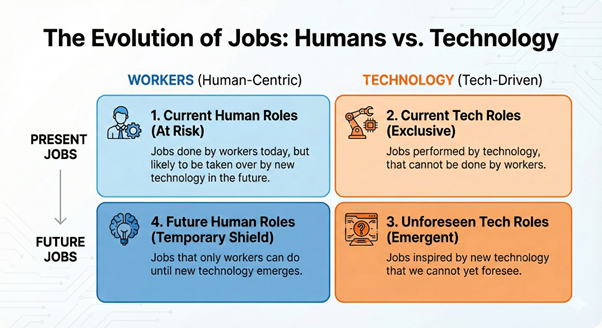
What’s this chart actually showing me?
Think of it like a game of musical chairs, except the chairs keep multiplying and changing shape.
The chart splits work into four boxes. Top left? That’s your job today that a machine will probably do tomorrow. Top right? Work that machines already do that humans physically can’t. Bottom left? Jobs that’ll exist until the next wave of tech shows up. Bottom right? Careers we haven’t even invented yet because the technology doesn’t exist.
Here’s the thing everyone misses: this isn’t static. Your job isn’t locked in one box forever.
So AI is coming for my job. Should I panic?
Depends. Are you attached to doing things the hard way?
Look, every accountant who switched from ledgers to Excel didn’t lose their job. They stopped doing arithmetic and started analyzing what the numbers meant. The job changed. The title stayed the same.
Box 1 isn’t a death sentence. It’s a heads-up. If you’re doing repetitive work that follows clear rules, yeah, that’s getting automated. But the question isn’t “will my job disappear?” It’s “what part of my job will disappear, and what new part am I going to own?”
What’s an example of Box 2 jobs?
Weather prediction. Financial modeling at scale. Analyzing millions of medical images to spot patterns humans miss.
Nobody’s sitting there with a calculator doing compound interest on a billion-dollar derivatives portfolio. Nobody’s hand-drawing weather maps anymore. The technology does it faster and more accurately than any human could.
But here’s what’s interesting: these jobs didn’t eliminate humans. They created new roles. Someone has to interpret the model. Someone has to decide what to do with the prediction. Someone has to explain why the AI flagged that medical scan.
The machine handles the computation. The human handles the judgment.
Box 4 sounds exciting. What jobs don’t exist yet?
That’s the fun part. Nobody knows.
In 2005, “social media manager” wasn’t a job. In 2015, “podcast producer” was barely a thing. In 2020, “prompt engineer” sounded like nonsense.
Ten years from now? Maybe we’ll have “AI ethics auditors” who check whether algorithms are being fair. Maybe “digital twin architects” who create virtual versions of real-world systems. Maybe “human-AI collaboration designers” who figure out how to make teams of people and machines work together.
The pattern is always the same: new technology creates jobs we can’t imagine until the technology exists. Then suddenly those jobs feel obvious.
Everyone says “learn to code.” Is that the answer?
That’s like saying “learn Latin” in 1500. Technically useful, but missing the point.
Coding is becoming a tool, not a career. AI already writes basic code. Soon it’ll write complex code. The question isn’t whether you can write a for-loop. It’s whether you can figure out what problem needs solving and how to solve it.
The valuable skill isn’t syntax. It’s knowing what to build and why.
What’s the move then? How do I stay in Box 4 instead of Box 1?
Stop thinking like a task-doer. Start thinking like a problem-solver.
Here’s the difference: A task-doer says “I process insurance claims.” A problem-solver says “I help people get the money they deserve when bad things happen.” When AI automates claims processing, the first person is stuck. The second person says “great, now I can focus on the complicated cases where someone needs actual help.”
The jobs that stick around require things machines can’t do: judgment calls with incomplete information, dealing with humans who are upset or confused, creating something new instead of following a template, making ethical decisions in gray areas.
Box 4 isn’t about specific skills. It’s about staying useful as the tools change.
This feels like a lot. How fast is this actually happening?
Slower than the hype, faster than the preparation.
Everyone’s either screaming “AI will replace us all by Tuesday” or shrugging “nothing ever really changes.” Both are wrong.
The transition happens gradually, then suddenly. Touch-tone phones took decades to replace operators. Then the last ones disappeared in a few years. Self-checkout took forever to show up, then boom, half the grocery stores have them.
You’ve got time. But you don’t have infinite time.
What’s the one thing I should do right now?
Pick something you do that a machine could easily do. Then figure out what you do that requires actual human judgment.
Double down on that second thing. Get better at it. Make it visible. Make yourself the person who handles what the AI can’t.
Because here’s the secret everyone misses: Box 1 and Box 4 aren’t different locations. They’re different mindsets. You can be in Box 1 doing Box 4 work at the same job, or you can be in Box 4 doing Box 1 work.
The chart isn’t your destiny. It’s your choice.